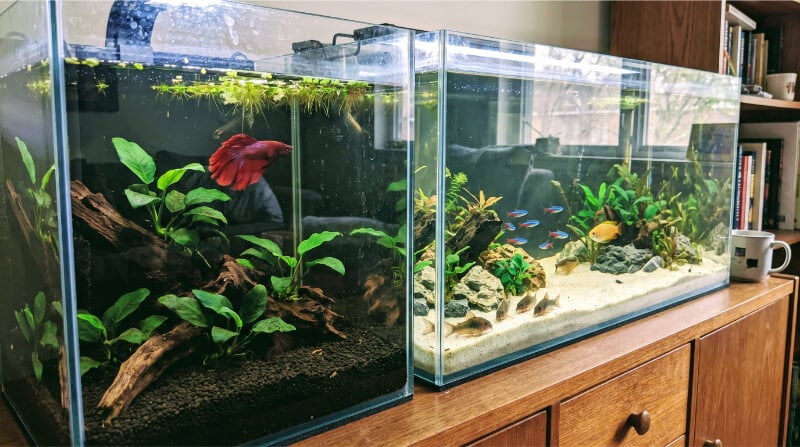
For most beginners choosing between a 10-gallon and 20-gallon aquarium, the 20-gallon is the better first tank. It provides more swimming room, supports more appropriate social groups, and its larger water volume helps buffer changes in temperature and water chemistry.
Choose the 10-gallon when space is genuinely limited or when you already want a focused setup such as one betta, one carefully selected nano species, or shrimp. Otherwise, the extra space of a 20-gallon usually gives you more flexibility for a relatively modest increase in footprint and maintenance.
10-Gallon vs. 20-Gallon at a Glance
| Factor | 10-Gallon | 20-Gallon Long |
|---|---|---|
| Typical footprint | About 20 x 10 in. | About 30 x 12 in. |
| Best use | Focused species setup | Small community |
| Water stability | Less buffering | More buffering |
| Stocking flexibility | Limited | Much greater |
| Stand requirements | Sturdy furniture may work | Dedicated stand strongly preferred |
| Maintenance | Slightly less water | Slightly more water |
| Beginner difficulty | Requires careful stocking | More forgiving |
| Best for | Betta, shrimp, select nano fish | Schooling fish and small community |
If you have room for either one, the 20-gallon long has the stronger overall case.
Table of Contents
🎥 Watch the Video: 10-Gallon vs. 20-Gallon Tanks
Why Tank Size Matters More Than Beginners Expect
A smaller aquarium looks simpler. There is less glass, less water, less substrate, and usually less equipment to buy.
But aquarium difficulty does not decrease in direct proportion to tank size.
A larger volume of water provides more buffering against environmental changes. The Ornamental Aquatic Trade Association notes that larger aquariums tend to be more stable and less susceptible to fluctuations in temperature and pH.
That does not mean a 10-gallon aquarium will crash every time you overfeed or postpone a water change. A mature biological filter, conservative stocking, live plants, feeding habits, and maintenance all influence how the aquarium responds.
What changes is your margin for error.
Ten gallons gives waste, evaporation, temperature changes, and accidental overdosing less water in which to disperse. Twenty gallons gives you more room to recognize and correct a problem.
That is one reason our first aquarium checklist recommends considering a 20-gallon tank when space allows.
When a 10-Gallon Aquarium Makes Sense
A 10-gallon tank is not a bad beginner aquarium. It simply works best when you have a specific reason for choosing it.
Choose 10 gallons when:
- Your available space cannot accommodate a 20-gallon long
- Your stand or location can safely support a 10-gallon but not a larger aquarium
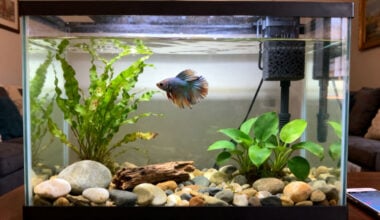
- You specifically want one betta
- You want a planted Neocaridina shrimp colony
- You have researched a nano species genuinely suited to the footprint
- You prefer a compact planted display over a mixed community
The strongest 10-gallon designs tend to be focused rather than crowded.
For example, our 10-gallon setup compares three separate approaches: a betta aquarium, a suitable nano-fish group, or a planted shrimp colony.
Trying to squeeze several small schools into the tank usually creates more problems than simply choosing one concept and doing it properly.
What a 10-Gallon Does Not Do Well
The word “nano” can be misleading. Tiny fish still have behavioral needs.
Many tetras, rasboras, and catfish require groups, and some need more horizontal swimming space than their body size suggests. Social fish should not be reduced to pairs or trios simply to fit more species into the aquarium. The RSPCA similarly notes that many commonly kept tetras, rasboras, danios, and catfishes should be maintained in groups.
That makes a 10-gallon a poor choice when your real goal is a traditional multi-species community.
Why a 20-Gallon Long Is Usually the Better Starter
The advantage of a 20-gallon is not simply that it holds twice as much water.
A 20-gallon long gives you approximately 30 inches of horizontal length, which creates significantly more usable swimming and bottom space.
That matters when you want:
- A proper school of small tetras
- A social group of appropriately sized corydoras
- A peaceful centerpiece fish
- Open swimming lanes
- Planted cover without filling the entire aquarium
- Distinct upper, middle, and bottom zones
Our 20-gallon blueprint uses eight neon tetras, six small corydoras of one species, and one honey gourami as a practical starting concept rather than downsizing each social group to squeeze in more varieties.
More Water Gives You More Buffer
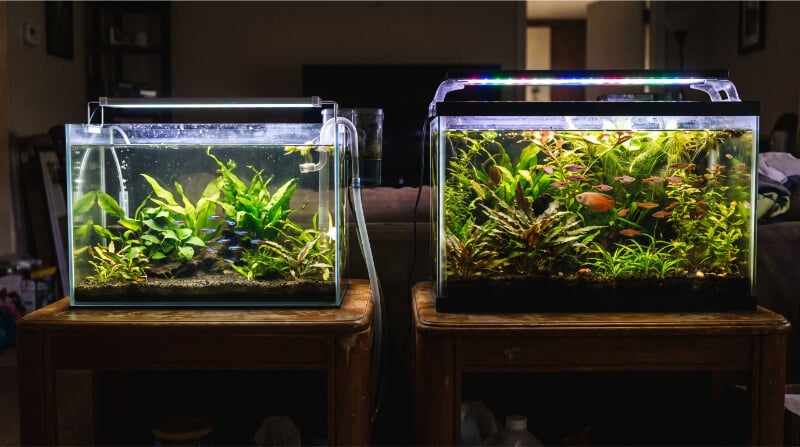
The aquarium still needs proper cycling and maintenance. Twenty gallons does not make ammonia harmless.
What it does provide is dilution.
Water-quality problems depend on stocking density, feeding, filtration, pH, temperature, and other factors. MSD Veterinary Manual identifies ammonia as one of the water-quality parameters capable of directly harming fish and emphasizes regular monitoring of nitrogen compounds.
This makes the 20-gallon especially attractive while you are still learning how feeding, filtration, stocking, and water changes interact.
Cost: Is a 20-Gallon Much More Expensive?
The tank itself is only part of the budget.
Both sizes generally need:
- Filter
- Heater for tropical livestock
- Thermometer
- Light
- Water conditioner
- Test kit
- Substrate
- Plants or decorations
- Siphon
- Fish food
The 20-gallon may require a larger heater, more substrate, a longer light, and somewhat greater filtration capacity. But items such as the test kit, conditioner, siphon, thermometer, and many maintenance supplies cost essentially the same regardless of tank size.
That means doubling the aquarium volume does not necessarily double the total setup cost.
Before buying a filter, our guide to aquarium filter types explains why both sponge and hang-on-back filters can work across this size range depending on livestock and desired mechanical filtration.
Space and Weight Matter More Than the Gallon Number
This is where the 10-gallon can win decisively.
A standard 10-gallon requires roughly 20 by 10 inches of surface area. A 20-gallon long requires roughly 30 by 12 inches.
Ten extra inches may not sound significant until you try to fit the aquarium into a bedroom, office, dorm, or apartment.
The larger tank also becomes substantially heavier once filled with water, substrate, rocks, wood, and equipment.
Do not assume a dresser or bookshelf can support either aquarium simply because the tank physically fits on top. The surface must be level, stable, and capable of safely supporting the complete setup.
For a 20-gallon, a purpose-built aquarium stand is usually the safer solution.
Maintenance: Which Tank Takes More Work?
The difference is smaller than many beginners expect.
A 20-gallon requires you to remove and replace more water, but the basic routine remains almost identical.
For either tank:
- Observe the fish for behavioral or health changes.
- Check temperature and equipment.
- Test water when appropriate.
- Remove debris and uneaten food.
- Perform a partial water change based on water quality.
- Trim damaged plant growth.
- Clean filter media when flow declines.
Water-change volume should respond to stocking and measured water quality rather than a rigid percentage.
OATA recommends regular water-quality testing because maintaining a stable environment helps prevent harmful changes.
The 10-gallon may require less time to siphon, but it demands more discipline in stocking and feeding. The 20-gallon requires a few extra minutes of physical maintenance but gives you more environmental buffer.
What Can You Actually Keep?
Fish goals may settle the decision faster than anything else.
| Goal | Better choice |
|---|---|
| One betta | 10-gallon |
| Neocaridina shrimp colony | 10-gallon |
| One suitable nano species | 10-gallon |
| Small tetra school | 20-gallon |
| Corydoras group | 20-gallon |
| Multi-species community | 20-gallon |
| Centerpiece plus schooling fish | 20-gallon |
| Very limited physical space | 10-gallon |
Do not use generic “one inch of fish per gallon” rules to make this decision. Adult size, behavior, swimming space, territorial needs, social groups, filtration, and waste production matter more.
Our stocking guide explains why aquarium capacity cannot be reduced to one simple fish-per-gallon formula.
So, Should You Buy a 10-Gallon or 20-Gallon?
Choose the 10-gallon when its smaller footprint solves a real constraint or when you deliberately want a focused small-tank concept.
Choose the 20-gallon when:
- You have enough space
- The additional equipment cost is manageable
- You want multiple fish species
- You want proper social groups
- You are still deciding which fish appeal to you
- You want more flexibility as your interest in the hobby grows
For the average beginner with room for both, the 20-gallon long is the better first aquarium.
It gives you more options without becoming dramatically more complicated to maintain. More importantly, it gives the fish more room and gives you more flexibility when the aquarium you imagined before entering the hobby changes after you start researching species.
A 10-gallon can be excellent when you choose it deliberately. A 20-gallon is simply harder to outgrow.
FAQ’s
Is a 10-gallon or 20-gallon tank better for beginners?
A 20-gallon is usually better for beginners because its larger water volume offers more stability, greater stocking flexibility, and more room for proper social groups.
Is a 10-gallon aquarium harder to maintain?
A 10-gallon is not inherently difficult, but its smaller water volume provides less buffering against temperature and water-quality changes, so careful stocking matters more.
Does a 20-gallon aquarium require much more maintenance?
A 20-gallon requires slightly more water and cleaning time, but the basic routine is almost identical. Its added stability can actually make daily aquarium management easier.