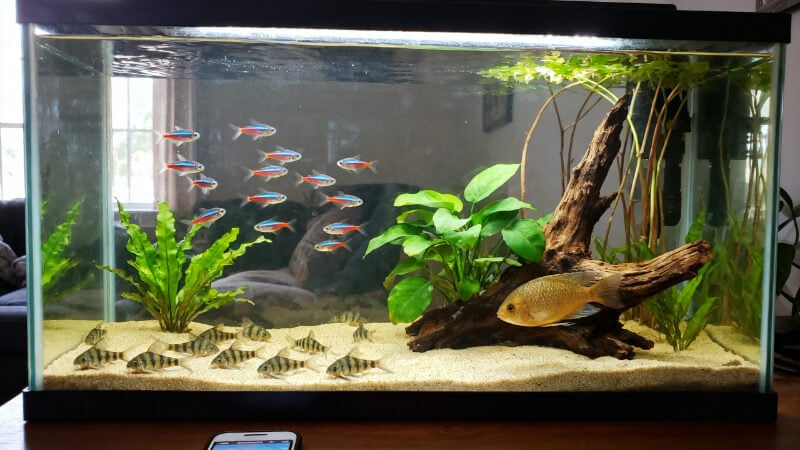
The most reliable 20-gallon community tank is not built by squeezing in as many attractive fish as possible. It is built around adequate social groups, compatible water and temperature needs, manageable waste production, and enough swimming space for each species.
A practical starting blueprint is a 20-gallon long aquarium with eight neon tetras, six small corydoras of one species, and one peaceful centerpiece fish such as a honey gourami. Add easy plants, moderate filtration, and a consistent weekly routine.
This combination creates activity at every level of the aquarium without treating the tank like a fish-storage container.
Table of Contents
20-Gallon Community Tank at a Glance
| Category | Practical starting point |
|---|---|
| Tank | 20-gallon long |
| Midwater fish | 8 neon tetras |
| Bottom fish | 6 small corydoras of one species |
| Centerpiece fish | 1 honey gourami |
| Substrate | Fine sand or smooth gravel |
| Plants | Anubias, Java fern, and beginner stem plants |
| Filtration | Sponge filter or adjustable hang-on-back filter |
| Temperature | Approximately 74°F to 77°F |
| Lighting | Start with 6 to 8 hours daily |
| Maintenance | Weekly partial water change based on test results |
This is a starting blueprint rather than a universal formula. Your source water, fish species, filtration, plant growth, and maintenance habits still affect what the aquarium can support.
Table of Contents
- Why a 20-gallon long is usually better
- Choosing a balanced fish community
- Plants that improve the setup
- Filtration, heating, and lighting
- A realistic maintenance routine
- Common mistakes to avoid
🎥 Watch the Video: Build a Healthy 20-Gallon Tank
Why a 20-Gallon Long Is Usually Better
Standard 20-gallon aquariums commonly come in long and tall formats. Both hold approximately the same volume, but they do not provide the same usable habitat.
A 20-gallon long typically measures about 30 inches from side to side. That additional horizontal length gives schooling fish more room to swim and provides a larger bottom footprint for corydoras.
It also makes it easier to create several functional zones:
- Open swimming space through the center
- Planted cover along the back and sides
- Sheltered areas around wood and rocks
- Accessible substrate for bottom-dwelling fish
- Calm areas where a centerpiece fish can retreat
A taller tank may work well for certain aquascapes, but extra height does not help most small community fish as much as extra length. For this stocking plan, the long format is generally the stronger choice.
Cycle the Aquarium Before Fully Stocking It
Before choosing fish, the aquarium must develop a functioning biological filter. The aquarium nitrogen cycle converts toxic ammonia into nitrite and then nitrate, but the process should be verified through water testing rather than assumed complete after a fixed number of weeks.
A new aquarium is ready for normal stocking only when its biological filter can process the ammonia being added without leaving detectable ammonia or nitrite.
Watch these three measurements closely:
| Parameter | Target in a cycled aquarium |
| Ammonia | 0 ppm |
| Nitrite | 0 ppm |
| Nitrate | Present but controlled through maintenance |
The MSD Veterinary Manual’s aquarium-fish guidance also emphasizes monitoring ammonia, nitrite, and nitrate during cycling instead of relying only on elapsed time.
Author Note: A tank may cycle quickly when established biological media is transferred from a healthy aquarium. Another setup may take considerably longer. The test results matter more than the calendar.
A Balanced 20-Gallon Stocking Plan
A community tank works best when fish are selected as social groups rather than as individual decorations. Each species needs adequate companions, suitable territory, and environmental conditions that overlap with the rest of the community.
The following combination spreads activity across the aquarium:
| Fish | Suggested number | Primary area |
| Neon tetras | 8 | Middle |
| Small corydoras | 6 | Bottom |
| Honey gourami | 1 | Middle and upper areas |
Add the groups gradually rather than introducing every fish at once. This gives the biological filter time to adjust and allows you to observe behavior before the tank is fully stocked.
Eight Neon Tetras
Neon tetras occupy the middle portion of the aquarium and create most of the visible group movement. Six is frequently described as a minimum, but a group of eight provides a stronger starting point when space and filtration allow.
These fish should not be expected to swim in a tight formation constantly. Schooling may become more noticeable when they feel threatened, while comfortable tetras often spread out and explore.
The neon tetra’s peaceful community behavior makes it suitable for calm tank mates that will not chase, intimidate, or outcompete it.
Avoid combining neon tetras with:
- Large predatory fish
- Persistent fin nippers
- Highly aggressive centerpiece fish
- Tank mates requiring substantially different temperatures
- Fish large enough to swallow an adult neon tetra
Author Note: Neons also benefit from planted cover and darker areas where they can retreat. A completely bare aquarium may leave them feeling exposed.
Six Small Corydoras
Corydoras are social fish and should not be added as a pair or trio simply because they occupy the bottom. A group of at least six members of the same species is a more appropriate foundation.
For a 20-gallon long, consider a smaller species such as:
- Pygmy corydoras
- Salt-and-pepper corydoras
- Panda corydoras
The exact species matters because corydoras can vary in adult size, activity level, and preferred temperature.
Corydoras search the substrate for food, but they are not aquarium maintenance equipment. They do not survive on waste, and they do not remove the need for water changes or substrate cleaning.
Feed them a complete sinking food and confirm that some food reaches the bottom before the tetras consume everything.
Fine sand or smooth, rounded gravel is preferable because it allows natural foraging and reduces the risk of injury to their sensitive barbels.
One Peaceful Centerpiece Fish
A single honey gourami is often a more cautious centerpiece choice than a dwarf gourami. Honey gouramis remain relatively small, tend to be peaceful, and generally fit well with small tetras and corydoras.
A dwarf gourami can also work, but the species deserves an important health caveat. Dwarf gouramis should be selected carefully from a reputable source because commercially produced fish may be affected by dwarf gourami iridovirus and other health problems.
A healthy-looking fish is not proof that disease is absent.
When adding any gourami:
- Introduce only one male to this setup
- Provide plants and visual barriers
- Watch for repeated chasing
- Confirm that tetras still feed normally
- Have a backup plan if aggression develops
Author Note: Compatibility is never guaranteed. The stocking plan improves the odds, but individual temperament and tank layout can still affect the outcome.
Plants That Make the Tank Easier to Manage
Live plants provide more than decoration. They create shelter, visual barriers, grazing surfaces, and areas where fish can retreat from constant activity.
Plants also absorb some nutrients from the water, but they do not replace filtration or maintenance.
Start with beginner aquarium plants that tolerate lower light, including Anubias and Java fern. Both are rhizome plants, meaning the thick horizontal rhizome should remain above the substrate.
Attach them to driftwood or rock rather than burying the rhizome.
Beginner Plant Layout
| Tank area | Plant options | Purpose |
| Foreground and hardscape | Anubias | Broad leaves and sheltered areas |
| Midground | Java fern | Height without demanding strong light |
| Background | Bacopa, water wisteria, or Ludwigia | Faster growth and visual depth |
| Open center | Minimal planting | Swimming room for tetras |
The Java fern’s low-light growth habit makes it especially useful around shaded wood and rock. Anubias can fill similar areas, although both plants grow slowly.
Add a faster-growing background plant such as water wisteria, Bacopa, or Ludwigia to provide height and absorb more available nutrients. Rotala can also work, but some varieties need stronger lighting and more consistent fertilization than beginners expect.
Keep planted areas along the back and sides while preserving open swimming room through the center. Corydoras also need accessible sections of substrate rather than a floor completely covered in dense vegetation.
Filtration, Heating, and Lighting
The equipment does not need to be expensive, but each item should serve a clear purpose.
Basic Equipment Checklist
| Equipment | What to look for |
| Filter | Appropriate flow, reusable media, and easy maintenance |
| Heater | Adjustable temperature control |
| Thermometer | Separate from the heater when possible |
| Light | Timer-compatible LED suitable for beginner plants |
| Test kit | Tests for ammonia, nitrite, and nitrate |
| Water conditioner | Treats chlorine or chloramine |
| Siphon and bucket | Reserved for aquarium use |
Sponge Filter or Hang-on-Back Filter?
A sponge filter can provide enough biological filtration and aeration for a responsibly stocked 20-gallon aquarium. It is quiet, inexpensive, and gentle enough for small fish.
Its main limitation is mechanical filtration. Sponge filters collect debris, but they may not polish the water as effectively as a hang-on-back filter containing sponge, floss, or another fine mechanical medium.
| Filter type | Advantages | Limitations |
| Sponge filter | Gentle flow, strong biological filtration, inexpensive | Limited water polishing, requires an air pump |
| Hang-on-back filter | Better mechanical filtration, easy media access | May create stronger flow and more noise |
| Dual sponge and HOB | Redundancy and balanced filtration | Additional equipment and maintenance |
A hang-on-back filter is a practical choice when you want stronger mechanical filtration. Look for adjustable flow, reusable media space, and an intake that can be covered with a pre-filter sponge.
Filter ratings printed on boxes are rough estimates, not stocking guarantees.
Author Note: Maintain either filter by rinsing reusable media in removed aquarium water or conditioned water when flow begins to decline. Do not replace all biological media at the same time.
Temperature
Use an adjustable heater and a separate thermometer to keep the temperature stable within the overlapping range of the selected species.
For neon tetras, appropriately selected small corydoras, and a honey gourami, approximately 74°F to 77°F is a practical target. Check the requirements of the exact corydoras species before purchasing it.
A stable temperature is generally more important than repeatedly chasing a precise number within the acceptable range.
Lighting
Start the aquarium light at six to eight hours per day. Increase the duration only when plant growth requires more light and algae remains controlled.
A timer makes the schedule consistent and prevents the light from being left on accidentally.
Ten or more hours of light is often unnecessary in a newly established aquarium and may contribute to algae before the plants become established.
A Maintenance Routine That Responds to the Tank
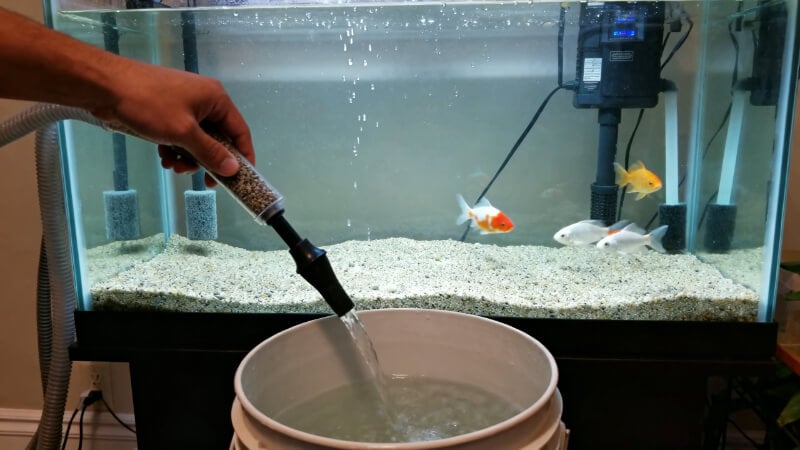
A weekly partial water change is a sensible baseline, but 25 percent is not a magic number. The necessary amount depends on nitrate accumulation, feeding, stocking, plant growth, and source-water chemistry.
Test regularly during the first several months. Ammonia and nitrite should remain at zero in a cycled aquarium. Nitrate should be controlled through water changes, plant growth, and appropriate feeding.
Weekly Maintenance Checklist
- Observe every fish for unusual breathing, hiding, injuries, or appetite changes
- Test ammonia and nitrite if the aquarium is new or anything appears wrong
- Check nitrate to determine whether the water-change routine is adequate
- Remove uneaten food and visible debris
- Siphon accessible areas without tearing apart the aquascape
- Replace water with conditioned water at a similar temperature
- Confirm that the filter and heater are operating normally
- Remove dead or deteriorating plant leaves
Monthly Equipment Check
Once a month, examine the equipment more closely:
- Confirm the heater maintains a stable temperature
- Check filter flow for signs of clogging
- Inspect air tubing and check valves
- Clean mineral deposits from the aquarium lid and light
- Trim overgrown stem plants
- Check electrical cords for damage
- Review whether fish growth has changed the tank’s needs
Author Note: Avoid dismantling the entire aquarium during routine maintenance. Excessive cleaning and rearranging can disturb fish, plants, and biological filtration.
Feeding Without Polluting the Tank
Feed small portions that the fish consume promptly, then adjust based on body condition and leftover food.
A fixed two-to-three-minute rule is too broad because food type, particle size, fish behavior, and the number of fish all affect how quickly a meal is eaten.
A better approach is to:
- Add a small portion.
- Watch which fish receive food.
- Add slightly more only when needed.
- Stop before food begins accumulating on the substrate.
- Provide a separate sinking food for corydoras.
Overfeeding may increase waste, but unexplained algae or cloudy water should not automatically be blamed on food alone.
Cloudiness can result from suspended debris, disturbed substrate, bacterial blooms, overfeeding, or an immature aquarium. Test the water before deciding on the remedy.
Common Mistakes to Avoid
Adding Every Fish at Once
Even after cycling, avoid adding the entire stocking plan on the same day. Introduce groups gradually while monitoring ammonia, nitrite, and behavior.
Keeping Too Few Social Fish
Do not reduce the corydoras group to two or three simply to make room for another species. Adequate social groups should take priority over variety.
The same principle applies to neon tetras. A proper group is more important than collecting several unrelated fish in small numbers.
Treating Bottom Feeders as a Cleanup Crew
Corydoras eat food that reaches the bottom, but they still produce waste and require a balanced diet. They cannot compensate for excess feeding or neglected maintenance.
Assuming Plants Make the Tank Self-Sustaining
Plants assist with nutrient management and provide shelter, but the aquarium still requires:
- Feeding
- Filtration
- Water testing
- Partial water changes
- Equipment checks
- Regular observation
Stocking Based Only on Clear Water
Clear water can still contain ammonia, nitrite, or excessive nitrate. Water clarity is not a reliable measure of safety.
Stocking decisions should be based on:
- Adult fish size
- Social group requirements
- Temperament
- Swimming and territory needs
- Temperature compatibility
- Filtration
- Measured water quality
- The keeper’s maintenance capacity
Replacing All Filter Media
Disposable cartridges encourage aquarists to throw away established biological media. Reusable sponge and ceramic media can usually be cleaned and retained rather than replaced on a schedule.
When media must be replaced, change only part of it at a time.
The Better 20-Gallon Blueprint
A successful 20-gallon community tank is not defined by one supposedly perfect list. It is defined by sensible social groups, compatible environmental needs, stable water quality, and a routine the keeper can maintain consistently.
A strong starting setup includes:
- One 20-gallon long aquarium
- Eight neon tetras
- Six small corydoras of one species
- One honey gourami
- Fine sand or smooth gravel
- Anubias and Java fern attached to hardscape
- Faster-growing background plants
- A sponge or hang-on-back filter
- An adjustable heater and thermometer
- Six to eight hours of daily lighting
- Weekly testing and partial water changes
That setup provides visible schooling, natural bottom-foraging behavior, a recognizable centerpiece fish, and enough flexibility to create an attractive planted aquarium.
The goal is not to fit the highest possible number of fish into 20 gallons. The goal is to create a community that remains manageable after the excitement of setting up the tank has passed.
FAQ’s
Is a 20-gallon long better than a 20-gallon tall?
A 20-gallon long is usually better because its 30-inch footprint gives schooling fish more horizontal swimming room and creates more usable bottom space for corydoras.
How many fish can live in a 20-gallon community tank?
Start with eight neon tetras, six small corydoras of one species, and one peaceful centerpiece fish. Final stocking still depends on filtration, plants, and maintenance.
Is a sponge filter enough for a 20-gallon aquarium?
A sponge filter can support a moderately stocked 20-gallon, but a hang-on-back filter provides stronger mechanical filtration. Either works when sized and maintained correctly.


