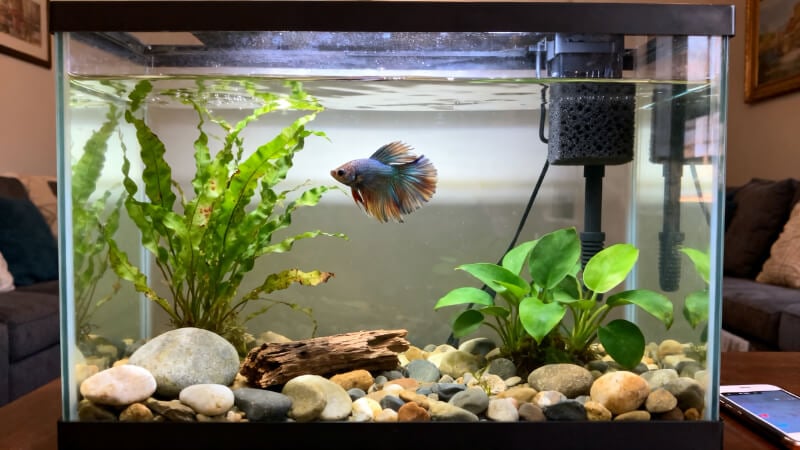
A 10-gallon aquarium works best when it is built around one clear stocking concept. Instead of combining several undersized social groups, choose a single betta, one appropriate nano fish group, or a planted shrimp colony.
That approach gives the livestock enough room, simplifies feeding, and makes water quality easier to manage. A 10-gallon tank can be an excellent first aquarium, but its limited volume leaves less room for overfeeding, overcrowding, temperature swings, and delayed maintenance.
Table of Contents
10-Gallon Tank Setup at a Glance
| Category | Practical starting point |
|---|---|
| Tank | Standard rectangular 10-gallon |
| Best stocking approach | One focused concept |
| Filtration | Small sponge filter or adjustable HOB |
| Heater | Adjustable heater for tropical livestock |
| Substrate | Fine sand, smooth gravel, or planted substrate |
| Plants | Java fern, Anubias, moss, and floating plants |
| Lighting | Start with 6 to 8 hours daily |
| Maintenance | Weekly testing and partial water changes |
The three stocking plans below are alternatives. They are not meant to be combined in the same aquarium.
Table of Contents
- Why small aquariums require careful planning
- Three suitable stocking concepts
- Plants and layout
- Equipment for a 10-gallon tank
- Maintenance and feeding
- Mistakes that destabilize small tanks
🎥 Watch the Video: Build a Better 10-Gallon Tank
Why 10-Gallon Tanks Require Careful Planning
A 10-gallon aquarium is not automatically unstable, but changes can become significant more quickly because there is less water to dilute waste, heat, and dissolved substances.
Larger aquariums generally provide more stable temperature and water conditions, which is one reason animal-welfare guidance encourages choosing more space when possible.
That does not mean a single extra feeding will always produce an immediate ammonia spike. The result depends on filtration, stocking, bacterial capacity, plant growth, and the amount of food added.
The most important safeguards are straightforward:
- Cycle the aquarium before normal stocking
- Avoid mixing species that need larger groups
- Test the water instead of judging it by appearance
- Feed according to the livestock, not a fixed timer
- Maintain a stable temperature
- Leave enough open space for normal movement
Cycling Is Not Slower Because the Tank Is Smaller
A 10-gallon aquarium does not inherently require more time to cycle than a 20-gallon. Cycling speed depends on factors such as temperature, pH, oxygen, ammonia availability, filter media, and whether established biological media is used.
During cycling, bacteria develop that process ammonia into nitrite and then nitrate. Both ammonia and nitrite can harm fish, so the process should be monitored with regular testing.
The aquarium is ready only when testing confirms that the biofilter can process the ammonia source without leaving measurable ammonia or nitrite.
The aquarium nitrogen cycle should be confirmed through testing, not declared complete after an automatic six or eight weeks.
Three Better Ways to Stock a 10-Gallon Tank
A small aquarium cannot simply be treated as a reduced version of a larger community tank. Many tiny fish still require sizeable groups and more swimming length than their body size suggests.
Choose one of the following concepts.
| Concept | Livestock | Best feature |
| Betta aquarium | 1 betta, optional snail | Strong centerpiece fish |
| Nano fish aquarium | 1 suitable species in a proper group | Active group behavior |
| Shrimp aquarium | 10 or more Neocaridina shrimp | Color, breeding, and plant detail |
Option 1: A Single Betta Aquarium
One betta is one of the clearest uses for a planted 10-gallon aquarium. The tank provides more swimming room and environmental variety than the small bowls and desktop containers still associated with the species.
The betta’s tank should include warm water and gentle filtration. A heater is normally required because bettas are tropical fish, and a temperature of approximately 76°F to 80°F is a practical target.
A good betta layout includes:
- Broad-leaved plants for resting
- Floating cover without blocking the entire surface
- Smooth wood or rounded decorations
- A secure lid
- Open access to the water’s surface
- Low or adjustable filter flow
The betta fish care guide explains its space and environmental needs in more detail.
A snail may work as an additional inhabitant, but individual bettas react differently. Some ignore snails, while others peck at their antennae. Avoid adding neon tetras or other active schooling fish merely because the tank appears empty.
Option 2: One Carefully Chosen Nano Fish Group
A 10-gallon aquarium can support certain nano fish, but the species must be selected carefully. “Small fish” does not automatically mean “10-gallon fish.”
Standard neon tetras are not the strongest choice for this footprint. They require a social group and benefit from more horizontal swimming space. Four neons do not create an adequate school.
Pygmy corydoras should not be kept as a pair either. They are social fish that need a proper group, and combining that group with another schooling species can crowd a standard 10-gallon quickly.
Better possibilities may include a species-only group of:
- Chili rasboras
- Ember tetras
- Celestial pearl danios
- Male Endler’s livebearers
Availability, group size, water chemistry, activity level, and adult size should all be checked before purchase. Some of these fish are better suited to experienced keepers or mature planted tanks.
Author Note: The key rule is simple: keep one appropriate nano species in a meaningful group instead of collecting several species in pairs or trios.
Option 3: A Planted Shrimp Colony
A planted Neocaridina shrimp aquarium makes especially effective use of 10 gallons. Shrimp create activity across plants, wood, glass, and substrate without requiring long open swimming lanes.
Start with approximately 10 shrimp to improve the likelihood of establishing a visible colony. A fully cycled, mature aquarium is preferable because shrimp graze on biofilm and microorganisms growing across established surfaces.
The cherry shrimp care guide describes the stable conditions these shrimp need, including gentle filtration and suitable water parameters.
Include:
- A sponge-covered filter intake
- Moss or fine-leaved plants
- Wood, stone, and textured grazing surfaces
- Stable mineral content
- Small portions of shrimp food
- No copper-based treatments unless confirmed safe for invertebrates
Shrimp consume biofilm, algae, and decaying plant material, but they still require appropriate supplemental food. They should not be treated as a substitute for maintenance.
Plants and Layout for a Small Aquarium
Plants are useful in a 10-gallon tank because they create shelter and break up sightlines without taking up the space required by bulky decorations.
A practical layout combines slow-growing plants on hardscape with faster-growing plants in the background.
| Area | Suitable plants |
| Driftwood or rock | Java fern and Anubias |
| Foreground | Moss or small Cryptocoryne |
| Background | Bacopa, water wisteria, or compact stem plants |
| Surface | Limited floating plants |
The Java fern’s rhizome should remain above the substrate. Attach the plant to rock or wood rather than burying its central growing structure.
Do not avoid planting merely because the tank is small. Instead, preserve open areas and trim plants before they block circulation or cover the entire surface.
Equipment That Fits the Tank
A small aquarium still needs full-sized life-support functions. Small does not mean equipment-free.
Essential Equipment Checklist
| Equipment | What matters |
| Filter | Gentle flow and enough biological media |
| Heater | Adjustable and appropriate for tank volume |
| Thermometer | Independent temperature confirmation |
| Light | Timer-compatible and suitable for plants |
| Test kit | Ammonia, nitrite, nitrate, and pH |
| Conditioner | Treats chlorine or chloramine |
| Lid | Reduces evaporation and prevents jumping |
A sponge filter is especially useful for bettas, shrimp, and small fish because it produces gentle flow and offers a safe grazing surface. A small hang-on-back filter also works when the current is adjustable and the intake is protected.
Filter turnover numbers should not be treated as guarantees. Media capacity, maintenance, stocking, and flow distribution matter as much as the printed gallons-per-hour rating.
A heater should be chosen according to the manufacturer’s recommended aquarium range. A 25-watt model may work in a warm room, while a colder room may require greater capacity. Use a thermometer to verify the result.
Author Note: Start the light at six to eight hours per day. Increase the duration only when plant growth requires it and algae remains manageable.
Weekly Maintenance Without Fixed Percentages
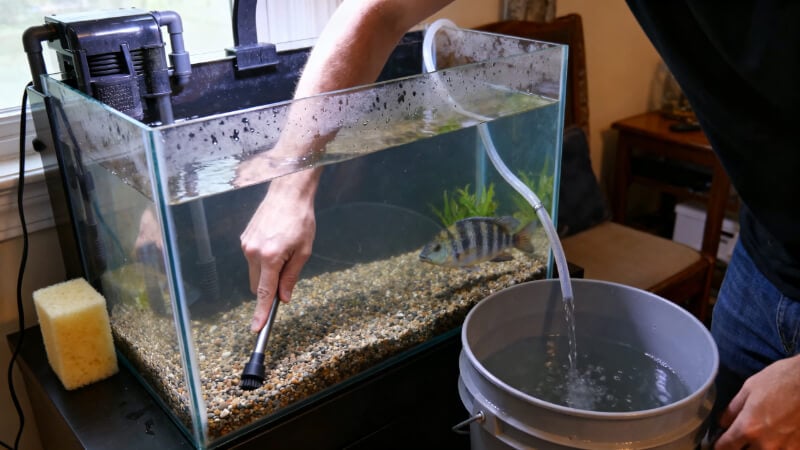
A 30 percent weekly water change can be a reasonable starting point, but the correct amount depends on measured water quality and how quickly waste accumulates.
Weekly Checklist
- Observe appetite, breathing, movement, and coloration
- Test ammonia and nitrite in new or troubled tanks
- Monitor nitrate trends
- Remove uneaten food and decaying leaves
- Change enough water to maintain suitable conditions
- Match replacement-water temperature closely
- Confirm normal filter flow and heater operation
- Top up evaporation with conditioned water when appropriate
Do not automatically clean the filter every week. Rinse reusable media gently when flow declines or debris accumulates, and avoid replacing all mature media at once.
Feeding
Feed a small amount and observe what is actually consumed. The correct portion depends on the species, food type, body condition, and number of animals.
A fixed two-to-three-minute rule can lead to overfeeding, especially with small fish or concentrated pellets.
For a betta, count and adjust suitable pellets according to their size and the manufacturer’s guidance. For nano fish, offer tiny food particles they can swallow. For shrimp, feed lightly enough that food does not remain for long periods.
Common 10-Gallon Mistakes
Avoid these frequent problems:
- Combining several incomplete social groups
- Adding fish before cycling is confirmed
- Assuming a small fish automatically fits
- Keeping tropical fish without stable heat
- Leaving the light on for excessive periods
- Replacing all filter media during cleaning
- Treating shrimp or bottom dwellers as cleaners
- Diagnosing cloudy water without testing
Cloudy water does not automatically mean the filter is clogged. It may come from substrate dust, suspended debris, excess food, bacterial growth, or a newly established aquarium.
Author Note: Test ammonia and nitrite first, observe the livestock, and identify the likely cause before cleaning or replacing equipment.
The Better 10-Gallon Blueprint
The most dependable approach is not a miniature mixed community containing four neon tetras, two pygmy corydoras, and one dwarf gourami. That setup compromises social group needs and leaves little room for behavior problems or waste.
Instead, build the aquarium around one concept:
- One betta in a warm, planted, low-flow setup
- One genuinely suitable nano species in a proper group
- A planted Neocaridina shrimp colony
That choice gives the tank a clearer purpose and makes every later decision, from filtration to feeding, easier to manage.
FAQ’s
What fish are best for a 10-gallon tank?
A 10-gallon tank works especially well for one betta, a carefully chosen nano fish group, or a planted shrimp colony. Choose one concept instead of mixing all three.
Does a 10-gallon aquarium need a heater?
Most 10-gallon aquariums need a heater when they house tropical fish. Use an adjustable model and thermometer to maintain the stable range required by the chosen species.
Does a 10-gallon tank take longer to cycle?
A 10-gallon tank is not harder to cycle solely because it is smaller. Cycling time depends on the ammonia source, temperature, pH, seeding, filtration, and regular testing.


