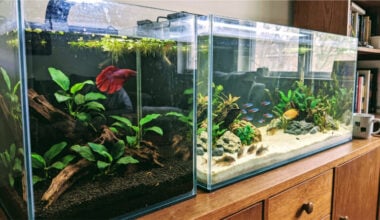
Stocking a fish tank seems simple at first. You pick fish you like, bring them home, and enjoy the view. Easy, right?
That’s exactly what I thought when I set up my first aquarium, and I learned the hard way that stocking is way more strategic than most beginners realize.
Before I add a single fish now, I always map out a plan. I’ll even use a fish stocking calculator to get a rough idea of capacity. It’s a great starting point. Specially if it accounts for compatibility factors like personality, territory, and aggression.
If you want a tank that looks balanced, stays healthy, and avoids constant fish drama, here’s how I approach stocking, plus what I avoid at all costs.
Table of Contents
Step 1 – Start With a Stocking Plan (Before Buying Anything)
Impulse buys are fun… until they aren’t.
Every successful tank I’ve built started with a clear plan. I decide what role each fish will play before I ever step into the store.
Think in Zones (Top, Middle, Bottom)
One of the easiest ways I balance a tank is by thinking vertically.
- Top swimmers
- Mid-level swimmers
- Bottom dwellers
When I spread fish across these zones, the tank feels active without feeling crowded.
For example, a yoyo loach works great as an active bottom fish in a larger setup. It constantly explores and adds personality without competing for mid-water space.
On the smaller end, something like a bumblebee goby can fill a bottom niche in a nano setup, but only if I account for its specific care needs and compatibility.
When every fish fights for the same territory, stress skyrockets. Spreading activity zones keeps things calm.
Always Consider Adult Size — Not Store Size
This is where a lot of stocking plans fall apart.
That adorable 2-inch juvenile at the store? It might double or triple in size.
An electric blue acara looks manageable in a 40-gallon when it’s young, but it grows into a substantial cichlid with real presence. A green terror grows even larger and carries far more aggression to match.
If I stock based on current size instead of adult size, I’m basically planning to rehome fish later, or deal with chaos.
I stock for the tank I have, not the fantasy version of it.
Step 2 – Pay Close Attention to Temperament
Tank size matters. But temperament can matter even more. According to the College of Veterinary Medicine, “you should pay attention to the way your new fish is acting in its environment“.
“Community Fish” Doesn’t Always Mean Peaceful
The term community fish gets thrown around loosely.
Some fish are peaceful in theory but become territorial in confined spaces. Others are calm unless breeding. Some are peaceful compared to other cichlids, which still makes them semi-aggressive.
Take a bolivian ram, for example. It’s one of the more peaceful dwarf cichlids and can thrive in a well-planned community.
Now compare that to a convict cichlid. Totally different story. Convicts are hardy and fascinatin, but when they breed, they become absolute tank bosses.
And then there’s the rainbow shark. Beautiful fish. But territorial toward bottom dwellers and similar-shaped species. If I don’t account for its personality, I end up with constant chasing.
Before stocking, I ask:
- Is this fish territorial?
- Does it claim caves?
- Does it become aggressive when breeding?
- Does it need a group to feel secure?
Behavior drives compatibility more than color ever will.
Aggression + Territory = Overstocking Disaster
Here’s something I’ve learned: aggression gets worse when space feels limited.
A 75-gallon tank with clear territories and sight breaks can feel spacious. A bare 55-gallon with open lines of sight can feel like a battlefield.
If I mix territorial species without structure, problems multiply fast.
That’s why I design hardscape alongside stocking plans. Rocks, driftwood, plants, they aren’t just decorations. They’re boundaries.
Step 3 – Think About Bioload (Not Just Fish Count)
Stocking isn’t a math equation, it’s a biological one.
Why the “1 Inch Per Gallon” Rule Doesn’t Work
This old rule ignores body mass and waste production.
A chunky cichlid produces far more waste than a slender tetra of the same length. A messy eater impacts water quality differently than a light grazer.
Instead of inches, I think about:
- Body mass
- Feeding habits
- Activity level
- Waste output
That’s where a fish stocking calculator can give a rough baseline, but it’s not the final authority.
Match Stocking to Filtration and Maintenance
If I want a heavier bioload, I need:
- Strong filtration
- Consistent water changes
- Stable parameters
Overstocking with weak filtration is a recipe for stress, disease, and algae.
I always ask myself:
Can I realistically maintain this bioload long term?
If the answer is “probably,” I dial it back.
What I Always Do When Stocking a Tank
Here’s my personal checklist:
- Add fish gradually. I never dump a full stock list in at once.
- Add the least aggressive fish first. Let them establish territory.
- Research each species individually. Even within cichlids, behavior varies widely.
- Plan for groups when needed. Schooling fish feel safer in proper numbers.
- Leave breathing room. Not every inch of water needs a fish in it.
A slightly understocked tank almost always looks better than an overcrowded one.
What I Never Do (Stocking Mistakes to Avoid)
These are the traps I avoid now:
- I don’t impulse buy.
- I don’t mix aggressive cichlids randomly.
- I don’t ignore adult size.
- I don’t overstock just because the tank “looks empty.”
- I don’t forget hiding spots and territory breaks.
And I definitely don’t assume a fish labeled “semi-aggressive” will behave itself without proper planning.
Example: How I’d Stock a Balanced 40-Gallon Community
Here’s how I might approach a peaceful 40-gallon breeder:
- Mid-level schooling fish (in a proper group)
- One peaceful centerpiece fish
- Bottom-dwelling clean-up crew
- Maybe a small algae grazer
I’d avoid mixing multiple territorial centerpieces. I’d keep personalities compatible. I’d structure the tank with plants and wood.
The goal isn’t to cram the tank full. The goal is to create harmony.
Final Thoughts: Stock Smart, Not Just Full
The biggest shift in my fishkeeping journey happened when I stopped asking:
“How many fish can I fit in this tank?”
And started asking:
“What combination will thrive here long term?”
Using a fish stocking calculator is a smart starting point. But real success comes from understanding behavior, territory, adult size, and bioload.
When I stock with intention instead of impulse, I get:
- Less aggression
- Better water quality
- Healthier fish
- A tank that feels natural
And honestly? That’s way more satisfying than squeezing in one extra fish.
FAQ’s
How accurate is a fish stocking calculator?
A fish stocking calculator is a helpful starting point, but it doesn’t account for aggression, territory, adult size, or filtration strength. I use it for rough estimates, then adjust based on species behavior and bioload.
What is the biggest mistake when stocking an aquarium?
The most common mistake is ignoring adult size and temperament. Many fish sold as juveniles grow much larger and may become territorial, which can quickly lead to overcrowding and aggression.
How many fish can I put in my tank?
It depends on tank size, filtration, species compatibility, and maintenance routine. Instead of focusing only on numbers, I recommend planning around swimming zones, adult size, and bioload for long-term success.