The best aquarium filter is not automatically the largest, most powerful, or most expensive option. It is the filter that provides enough biological media, mechanical filtration, and circulation for the aquarium’s size, livestock, and waste load.
Sponge filters excel in gentle setups. Hang-on-back filters are practical for many community tanks. Canister filters offer more media capacity and flexible flow for larger or heavily stocked aquariums. The right choice depends on the tank, not a universal ranking.
The accompanying video compares five filter types in a decision-help format for beginner and intermediate fishkeepers. This article expands on that framework without duplicating the video.
Table of Contents
What an Aquarium Filter Actually Does
Aquarium filtration is commonly divided into three categories:
- Mechanical filtration traps solid waste, uneaten food, and suspended debris.
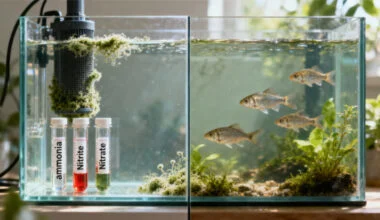
- Biological filtration provides surface area for bacteria that process ammonia and nitrite.
- Chemical filtration uses media such as activated carbon to remove selected dissolved compounds.
Biological and mechanical filtration are essential in most recirculating aquarium systems. Chemical media can be useful, but it is not always necessary for routine freshwater filtration. The MSD Veterinary Manual provides a useful explanation of how the three types of aquarium filtration work together.
A filter must also circulate water and contribute to surface movement. However, more flow is not always better. Bettas, fry, and some shrimp setups benefit from gentle movement, while larger or heavily stocked tanks usually need stronger circulation.
🎥 Watch the Video: Aquarium Filter Types Compared
Start With Bioload, Not Tank Size Alone
Tank size provides a starting point, but it does not describe the filter’s entire workload.
A lightly stocked 40-gallon planted aquarium may create less waste than a crowded 20-gallon containing large, messy fish. Feeding habits, adult fish size, plant debris, and maintenance frequency all affect the bioload.
Before selecting a filter, consider:
- Aquarium volume and dimensions
- Adult size and number of fish
- Waste production
- Preferred current strength
- Whether fry or shrimp need intake protection
- Available space behind or below the tank
- Noise tolerance
- Ease of cleaning
- Amount and type of filter media
Matching equipment to the livestock is one of the simplest ways to prevent recurring aquarium problems. The Aquarium Source glossary explains how upgrading filtration can mean improving media, flow, or bioload capacity, rather than simply buying a larger unit.
Sponge Filters: Best for Gentle Flow
A sponge filter uses an air pump to draw water through porous foam. The sponge catches some particles while providing a large colonization surface for beneficial bacteria.
Sponge filters are especially useful for:
- Betta tanks
- Shrimp aquariums
- Fry and breeding tanks
- Quarantine setups
- Lightly stocked nano tanks
- Aquariums that need additional biological filtration
Their biggest advantage is safety. There is no powerful intake opening that can pull in fry or juvenile shrimp. The flow can also be adjusted with an airline control valve.
For shrimp colonies, a sponge filter provides gentle flow without pulling babies into an intake, making it one of the most practical filtration choices.
The limitations are mostly mechanical. Sponge filters do not polish water as effectively as fine filter floss, and they do not include dedicated trays for chemical media. Air pumps can also produce humming or bubbling noise.
Author Note: A single small sponge filter may not provide enough circulation or waste collection for a heavily stocked large aquarium. Larger tanks can still use sponge filtration, but they may need multiple filters or another filtration system alongside them.
Hang-On-Back Filters: The Practical All-Rounder
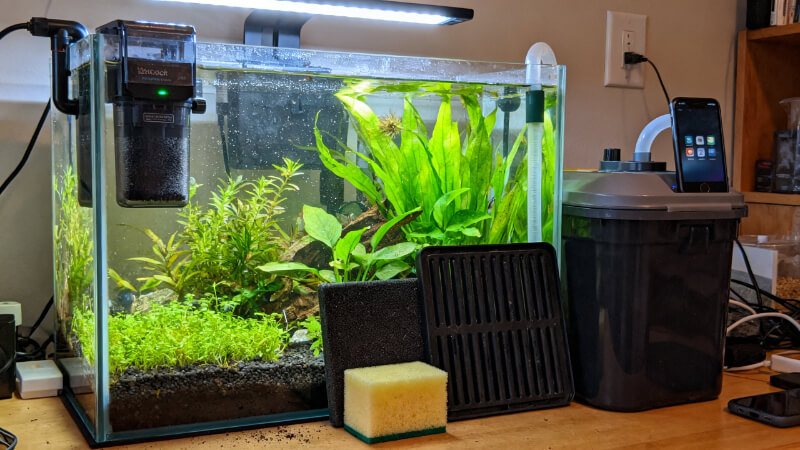
A hang-on-back filter, or HOB, hangs from the aquarium rim. It draws water through an intake tube, passes it through media, and returns it through a waterfall-style outlet.
HOB filters are popular because they are:
- Easy to install
- Widely available
- Simple to open and clean
- Suitable for several media types
- Reasonably priced
- Effective in many small and medium community tanks
They are often a strong choice for aquariums between 10 and 40 gallons, but that range is not a fixed rule. The appropriate model depends on media capacity, actual flow, and bioload.
The intake should be covered with a pre-filter sponge when keeping small fish, shrimp, or fry. This adds protection and creates another biological surface.
Waterfall returns improve surface agitation, but they can become noisy when the water level drops. Strong output can also bother bettas or other fish that prefer calm water. Raising the water level or using a flow baffle can reduce that problem.
Author Note: Disposable cartridges are another concern. Replacing the entire cartridge can remove much of the filter’s established bacterial population. Reusable sponge and biological media are usually more stable and economical when the filter allows customization.
Canister Filters: Best for Capacity and Flexibility
Canister filters are sealed external units that usually sit below the aquarium. Water travels through an intake hose, passes through stacked media baskets, and returns through a nozzle or spray bar.
Their biggest advantages are:
- Large media capacity
- Customizable media arrangement
- Strong mechanical filtration
- Flexible return flow
- Hidden equipment
- Longer intervals between cleanings
- Suitability for large or heavily stocked tanks
Canister filters can hold coarse sponge, fine floss, ceramic biological media, and optional chemical media in separate layers. Aquarium Source’s canister guide explains how stacked media trays allow filtration to be customized for the aquarium’s needs.
A spray bar can distribute flow across a long tank instead of directing a concentrated jet at one area. This is useful in planted aquariums and setups containing fish that prefer moderate circulation.
Canister filters are not automatically required for every tank above 40 gallons. A properly sized HOB, sump, or multiple sponge filters may also work. However, canisters become especially attractive as water volume, stocking, and mechanical waste increase.
The tradeoffs are cost and maintenance. Cleaning requires closing valves, disconnecting hoses, opening the unit, and rinsing the media. Poorly maintained hoses or impellers can reduce flow, and a leaking seal can cause water damage.
Internal Filters: Compact but Visible
Internal filters are submerged inside the aquarium and commonly attach to the glass with suction cups.
They can be useful for:
- Hospital tanks
- Quarantine aquariums
- Temporary setups
- Small tanks with limited external space
- Adding localized circulation
Their main disadvantages are limited media capacity and the space they occupy inside the aquarium. Some models also create concentrated flow that must be positioned carefully.
Author Note: Internal filters are not inherently poor. A well-sized model can filter a small aquarium effectively. They simply offer less media flexibility and are more visible than HOB or canister systems.
Undergravel Filters: Effective in Specific Setups
An undergravel filter uses a perforated plate beneath a gravel bed. Airlift tubes or powerheads draw water through the gravel, allowing the substrate to function as biological media.
These filters can work, but they require a compatible setup and consistent gravel vacuuming.
Potential drawbacks include:
- Debris collecting within the gravel
- Difficulty inspecting the area under the plate
- Reduced performance if the substrate becomes clogged
- Limited compatibility with fine sand
- Complications when keeping heavily rooted plants
It is inaccurate to say that every undergravel filter destroys plant roots or inevitably creates toxic gas. The real concern is that poor maintenance can allow waste to accumulate and reduce water movement through parts of the substrate.
For most modern planted aquariums, a sponge, HOB, or canister filter is easier to manage.
Choosing a Filter by Tank Type
Nano tanks under 10 gallons
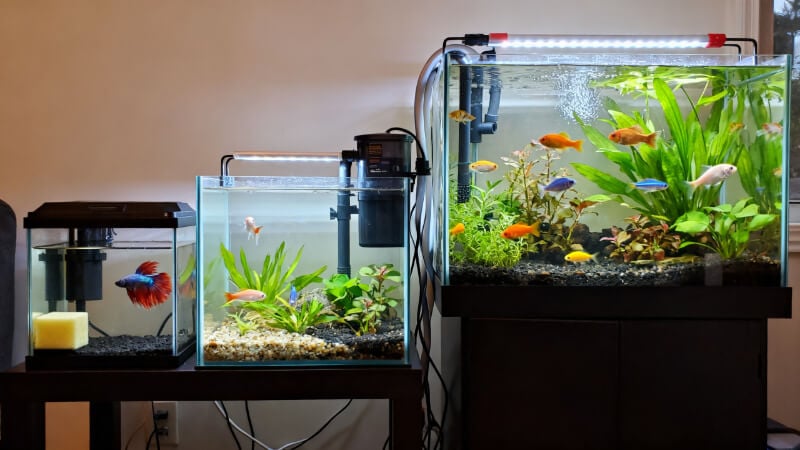
A sponge filter is usually the safest starting point. It provides gentle flow, biological filtration, and protection for small inhabitants.
Tanks from 10 to 20 gallons
Choose a sponge filter for bettas, shrimp, fry, or lightly stocked tanks. Choose an HOB when stronger mechanical filtration or greater media flexibility is needed.
Tanks from 20 to 40 gallons
An HOB works well for many lightly or moderately stocked communities. A canister becomes more useful when stocking is heavy, circulation is difficult, or additional media capacity is needed.
Tanks above 40 gallons
Canister filters are a strong option, but they are not the only valid choice. Match the filter’s real flow and media capacity to the livestock rather than relying only on the advertised tank rating.
Breeding and shrimp tanks
Sponge filters are generally the most practical option. Cherry shrimp and other dwarf shrimp can be pulled into exposed filter intakes, so blocking the intake or using sponge filtration reduces that risk.
Planted aquariums
Small low-tech planted tanks often work well with sponge or HOB filters. Larger planted aquariums benefit from canister filters because the return can be adjusted to distribute nutrients and carbon dioxide more evenly.
Surface agitation should not be eliminated entirely. Fish and beneficial bacteria still need oxygen. The goal is balanced circulation, not motionless water.
Maintain the Filter Without Damaging the Cycle
A high-quality filter can still fail when maintained incorrectly.
Use these basic practices:
- Clean media when flow declines or debris accumulates
- Rinse reusable media in removed aquarium water
- Avoid replacing all biological media at once
- Clear leaves and debris from the intake
- Inspect the impeller when the filter becomes noisy
- Follow the manufacturer’s instructions for seals and hoses
- Keep backup media or aeration available for emergencies
Beneficial bacteria colonize filter media and other submerged surfaces. Removing the primary biological media can lead to ammonia and nitrite increases while a new colony develops. Research aquarium systems use secondary biological media for exactly this reason.
Author Note: The objective is to remove trapped waste while preserving biological stability. A filter does not need to look sterile to work properly.
Final Thoughts
No aquarium filter ranks first in every category.
Sponge filters are excellent for gentle, biologically stable setups. HOB filters offer an accessible balance of performance and convenience. Canister filters provide greater media capacity and flow control for demanding aquariums. Internal and undergravel filters still have valid uses, but they fit a narrower range of setups.
Choose the filter by matching its flow, media capacity, intake design, and maintenance requirements to the aquarium’s livestock. That approach is more reliable than selecting equipment by price, popularity, or tank-size claims alone.
FAQ’s
What type of aquarium filter is best for beginners?
An HOB filter is a practical choice for many beginner community tanks, while a sponge filter is often better for bettas, shrimp, fry, and lightly stocked nano aquariums.
Is a canister filter better than a hang-on-back filter?
A canister offers more media capacity and flexible flow, but an HOB is easier to install and maintain. The better option depends on tank size, stocking, and bioload.
Can an aquarium filter be too powerful for fish?
Yes. Excessive current can stress bettas, fry, and other slow swimmers. Choose adjustable flow, add a baffle, or use a sponge filter when gentle circulation is required.