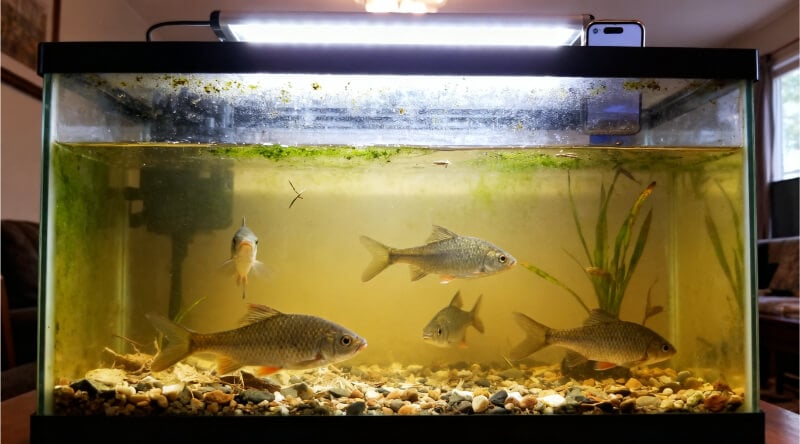
Skipping one water change usually doesn’t destroy an established aquarium. In many tanks, you may notice almost nothing.
The risk comes from making skipped water changes a pattern. Nitrate can accumulate, dissolved waste remains in the system, alkalinity may gradually be consumed, and the aquarium’s chemistry can drift farther from the replacement water you eventually add. A tank can look perfectly clear while those changes are happening.
Table of Contents
🎥 Watch the Video: What Happens Without Water Changes?
What Changes First?
In a cycled aquarium, beneficial bacteria convert ammonia to nitrite and then nitrate.
The filter does not make nitrate disappear.
Nitrate can leave the system through plant uptake, denitrification in specialized conditions, and most importantly for a typical freshwater aquarium, by removing old water and replacing it with new water. UF/IFAS identifies water changes as one of the normal ways nitrate is removed from aquarium systems.
Our nitrogen cycle guide explains the process in more detail.
So when routine water changes stop, one of the easiest changes to measure is often rising nitrate.
How quickly it rises depends on:
- Number and size of fish
- Feeding
- Plant growth
- Tank volume
- Source-water nitrate
- Maintenance
- How much organic waste is accumulating
That is why a fixed schedule is a starting point, not a substitute for testing.
Nitrate Doesn’t Have One Universal Danger Number
You will often see a single nitrate number presented as the dividing line between “safe” and “dangerous.”
Fish biology is not that tidy.
Sensitivity varies among species, life stages, and exposure durations. UF/IFAS aquarium guidance uses 40 ppm or less as a general freshwater recommendation, while veterinary references emphasize that nitrate toxicity varies and becomes more important in systems with limited water exchange.
Instead of obsessing over one universal cutoff, watch the trend.
If your aquarium normally sits at 10–15 ppm before maintenance and gradually begins reaching 30, 40, or higher, something in the system has changed.
Author Note: Testing before a water change can tell you whether your current routine is keeping up.
What Happens to pH and KH?
This is the more interesting long-term problem.
Nitrification and other biological processes gradually consume alkalinity. Alkalinity helps resist changes in pH.
If your source water has modest buffering and you repeatedly top off evaporated water without actually removing old aquarium water, the tank can gradually become more acidic.
At the extreme end is old tank syndrome.
MSD Veterinary Manual describes it as a condition associated with inadequate water changes, accumulation of organic acids, depleted alkalinity, very low pH, and eventually disruption of biological filtration.
That does not mean every aquarium that misses a few water changes is heading toward a pH crash.
Source-water alkalinity, stocking, feeding, substrate, rocks, plant growth, and other factors all change the rate.
But it explains why simply topping off evaporation is not the same thing as changing water.
Can Skipping Water Changes Cause More Algae?
Sometimes, but the relationship is not as simple as:
high nitrate = algae outbreak.
Algae responds to a combination of nutrients, light, plant competition, CO2 availability, and other conditions.
Allowing nutrients and organic material to accumulate can contribute to an environment where algae has more opportunity to grow, but a water change alone will not solve every algae problem.
If algae suddenly increases, identify the type first. Our guide to aquarium algae covers the common forms and their likely causes.
This is another reason visual appearance can be misleading.
A tank can have high nitrate and very little algae.
Author Note; Another can have low measured nitrate and plenty of algae because growing algae is consuming it.
What Happens to All the Physical Waste?
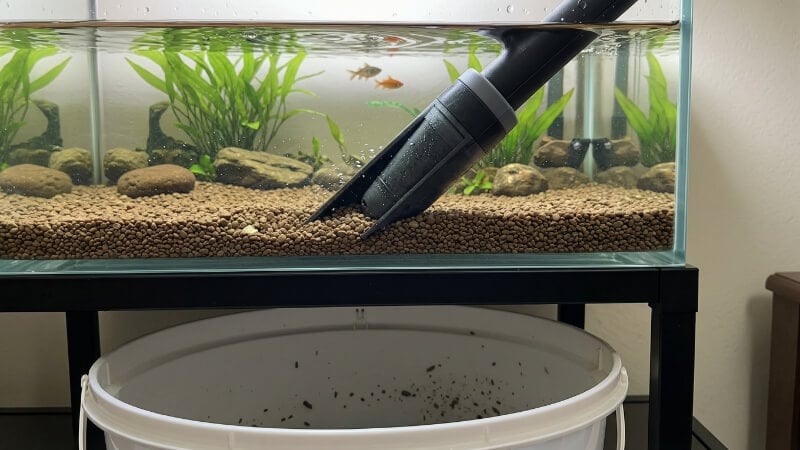
Water changes are often paired with another useful task: removing debris.
Uneaten food, fish waste, damaged leaves, and other organic material can settle into gravel and hard-to-reach areas.
That material does not instantly become poisonous.
Microorganisms gradually break much of it down.
But allowing excessive debris to accumulate increases the organic load of the aquarium and creates more material that eventually has to be processed.
This is why siphoning accessible dirty areas can be useful during maintenance without obsessively trying to sterilize every inch of substrate.
Our guide to clear aquarium water covers the relationship between feeding, filtration, testing, maintenance, and accumulated debris.
What About Hydrogen Sulfide?
Deep, oxygen-poor substrate can support anaerobic processes capable of producing hydrogen sulfide. Veterinary references recognize hydrogen sulfide as toxic to fish.
But I would not treat every dark patch in gravel as a hidden toxic-gas bomb.
For a normal freshwater aquarium, routine maintenance, avoiding excessive organic buildup, and keeping the substrate appropriate for the setup are more useful than worrying about dramatic substrate-release scenarios.
Do Planted Tanks Still Need Water Changes?
Live plants complicate the picture in a useful way.
Actively growing plants consume nitrogen and other nutrients, so a densely planted, lightly stocked aquarium may accumulate nitrate much more slowly than an unplanted aquarium with the same volume.
That is one reason some experienced keepers successfully use longer water-change intervals.
But nitrate is only one measurement.
Plants do not automatically prevent:
- Alkalinity changes
- Accumulated dissolved compounds
- Mineral imbalances
- Physical debris
- Poor source-water choices
Our low-maintenance aquarium guide uses plants, conservative stocking, and automation to reduce maintenance rather than pretending maintenance disappears entirely.
A planted tank can sometimes need less frequent water replacement.
That is different from saying it never needs any.
Does a Bigger Tank Let You Skip Changes Longer?
Not automatically.
Water volume provides dilution, but what really matters is bioload relative to water volume.
A lightly stocked 75-gallon aquarium may change chemistry much more slowly than a heavily stocked 10-gallon.
But a crowded 75-gallon full of large fish may accumulate waste faster than a lightly stocked planted nano tank.
Instead of choosing a schedule from tank size alone, track how your own aquarium behaves.
Author Note: Our 20-gallon community setup uses a weekly partial change as a practical baseline, then adjusts it according to nitrate, feeding, stocking, plant growth, and source-water chemistry.
How to Recover a Tank That Has Been Neglected
First, don’t assume that every neglected tank needs the same rescue plan.
Test:
- Ammonia
- Nitrite
- Nitrate
- pH
- KH or total alkalinity if possible
- Temperature
Then compare the tank water with your replacement water.
If the chemistry is reasonably close
A normal partial water change with conditioned, temperature-matched replacement water may be appropriate.
Our tap-water guide covers preparing replacement water safely.
If pH and alkalinity have collapsed
That is different.
In genuine old tank syndrome, suddenly raising pH while significant ammonia is present can increase the proportion of toxic un-ionized ammonia. MSD specifically recommends treating this as a water-quality emergency rather than blindly performing a routine water change.
If readings are severely abnormal or fish are already distressed, get experienced aquatic-veterinary or fish-health guidance rather than relying on a fixed percentage from an online article.
So How Often Should You Change Aquarium Water?
There is no magic percentage for every aquarium.
For many freshwater community tanks, a weekly partial water change is a sensible starting point.
Then let your aquarium tell you whether that is enough.
Monitor:
- Nitrate trends
- pH stability
- Alkalinity if relevant
- Fish behavior
- Feeding and waste
- Plant growth
- Visible debris
If your parameters remain stable with a different interval, the routine can be adjusted.
If you mainly hate hauling buckets, our automatic water change setup can remove much of that friction without eliminating actual water replacement.
Skipping one water change is rarely the issue.
The problem is allowing “I’ll do it next week” to become the aquarium’s permanent maintenance plan.
FAQ’s
What happens if I miss one aquarium water change?
Usually nothing dramatic in a stable tank. The concern is repeated neglect, which can allow nitrate, organic waste, and changes in alkalinity or pH to accumulate.
Can a fish tank survive without water changes?
Some lightly stocked, heavily planted systems can use long intervals, but no-water-change claims depend heavily on plant growth, stocking, feeding, and water chemistry.
How often should I change aquarium water?
A weekly partial change is a practical starting point for many community tanks. Adjust frequency and volume using nitrate trends, stocking, feeding, plants, and source water.