Undergravel filters are not obsolete, but they are far more specialized than modern sponge, hang-on-back, and canister filters. Their main advantage is simple: the aquarium’s gravel bed becomes a large biological filter.
That can work very well in a lightly to moderately stocked aquarium with coarse gravel and regular substrate maintenance. But undergravel filters become a poor fit when you want sand, aquasoil, digging fish, or a modern planted aquascape.
The technology still works. The question is whether it works for the aquarium you actually want to build.
Undergravel Filters at a Glance
| Factor | Undergravel Filter |
|---|---|
| Primary strength | Biological filtration |
| Filter media | Aquarium gravel |
| Best substrate | Coarse, uniform gravel |
| Sand compatible? | Generally no |
| Aquasoil compatible? | Poor choice |
| Mechanical filtration | Limited by itself |
| Moving parts underwater | Very few |
| Reverse-flow option | Yes |
| Best use | Simple gravel-based community tanks |
| Poor fit | Fine substrate, aquascapes, digging fish |
Table of Contents
🎥 Watch the Video: Are Undergravel Filters Underrated?
How Does an Undergravel Filter Work?
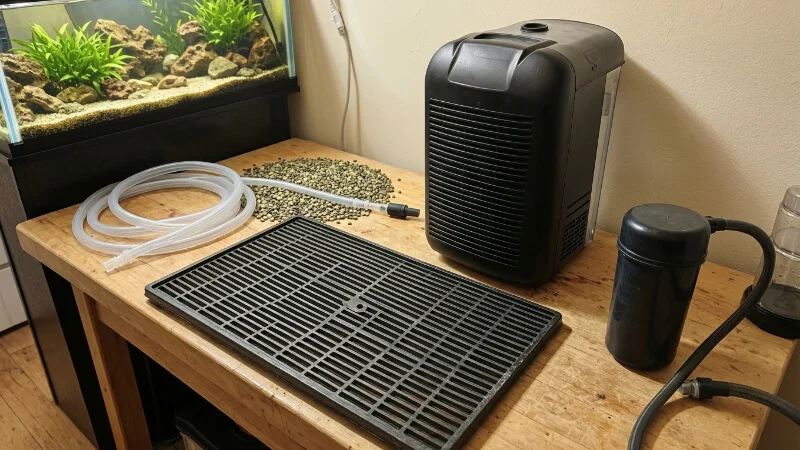
An undergravel filter uses a perforated plate installed underneath the aquarium substrate.
Uplift tubes connect the space beneath that plate to either an air pump or powerhead. In a traditional setup, water is pulled downward through the gravel, underneath the plate, and back up through the uplift tubes.
That flow turns the substrate into part of the filtration system.
The gravel provides a large surface where nitrifying bacteria can colonize. Water carrying ammonia and other dissolved compounds passes repeatedly across those bacteria as it moves through the substrate.
This is primarily biological filtration, although some suspended debris is also trapped between gravel particles.
Our guide to filter types explains how biological, mechanical, and chemical filtration play different roles in an aquarium. Undergravel filters lean particularly heavily on the biological side.
Why Using the Entire Gravel Bed Matters
Modern filters concentrate biological media inside a box, sponge, cartridge, or canister.
An undergravel filter takes a different approach.
Instead of sending aquarium water through a small dedicated media chamber, it sends water through much of the substrate bed. That potentially creates a substantial amount of colonizable surface area.
What the UGF is good at
- Providing continuous water movement through coarse gravel
- Supporting nitrifying bacteria throughout the substrate
- Aerating the lower substrate layers
- Operating with relatively simple components
- Providing filtration without a large filter body inside the aquarium
However, biological surface area alone does not make a filter automatically superior.
Author Note: A filter also needs appropriate flow, oxygen, access for maintenance, and enough capacity for the tank’s actual waste production.
That is why the right aquarium filter depends on livestock, substrate, flow requirements, and maintenance preferences rather than simply which filter has the most theoretical bacterial surface.
Standard vs. Reverse-Flow Undergravel Filters
This distinction changes the UGF conversation significantly.
Standard Flow
In a traditional undergravel filter:
- Water enters through the gravel surface.
- It moves downward through the substrate.
- It passes through the filter plate.
- It returns through the uplift tube.
The drawback is obvious. Fine organic debris can be drawn into the gravel along with the water.
Reverse Flow
A reverse-flow system moves water the opposite direction.
Mechanically filtered water is pumped down the uplift tubes, enters the space beneath the plate, and moves upward through the gravel.
Practical Fishkeeping describes reverse flow as the stronger approach when an external filter removes debris before the water reaches the gravel. This allows the gravel to continue providing biological filtration while helping keep detritus suspended for removal elsewhere.
| Standard UGF | Reverse-Flow UGF |
|---|---|
| Pulls water into gravel | Pushes water upward |
| Gravel traps more debris | Helps keep debris suspended |
| Simpler equipment | Usually needs additional filtration |
| Biological filtration | Biological filtration |
| More gravel vacuuming importance | Better debris management |
Reverse flow does not make the system maintenance-free. It simply addresses one of the traditional UGF’s biggest weaknesses.
Does Waste Really Build Up Under the Plate?
Yes, debris can accumulate in and below an undergravel system.
What matters is how quickly it accumulates and whether normal maintenance keeps the gravel permeable enough for water to continue moving through it.
The script that inspired this article included reports from long-term hobbyists who found surprisingly little material below old UGF plates. Those experiences are useful context, but they should not be treated as universal cleaning schedules.
Author Note: A heavily fed aquarium with large fish can behave very differently from a lightly stocked community tank.
Factors that increase debris accumulation
- Overstocking
- Heavy feeding
- Large waste-producing fish
- Infrequent gravel vacuuming
- Gravel with poorly matched particle size
- Uneven water flow
- Dead areas under decorations
Regular gravel vacuuming remains important with a traditional UGF.
The goal is not to sterilize the substrate. It is to prevent enough organic debris from accumulating that water flow through the gravel becomes restricted.
Substrate Choice Can Make or Break the System
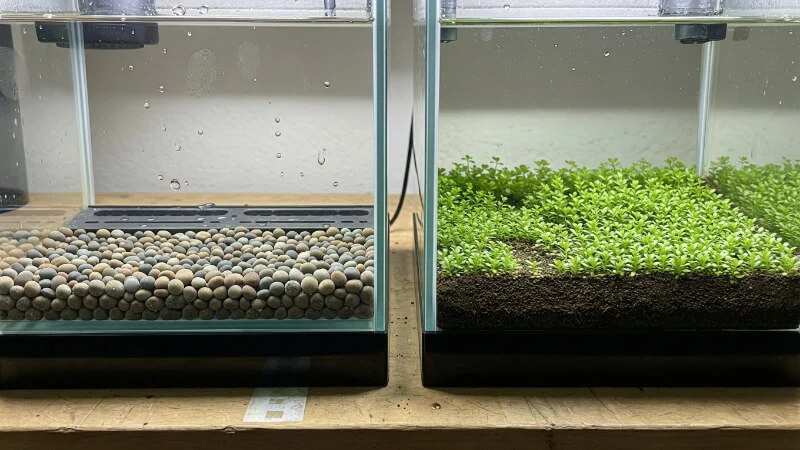
Undergravel filtration depends on water being able to pass easily through the substrate.
That immediately eliminates many popular modern substrates.
Generally suitable
- Medium aquarium gravel
- Rounded gravel with fairly uniform particles
- Gravel large enough to maintain spaces for water flow
Generally unsuitable
- Fine sand
- Very fine gravel
- Mud or soil substrates
- Many aquasoils
- Compact substrates that break apart easily
This is one reason UGFs disappeared from many modern aquascapes.
Today’s planted aquariums frequently rely on nutrient-rich soils, carpeting plants, and carefully layered substrates. Aquarium Source’s planted substrate guide includes aquasoils, sand, and layered substrates specifically designed around plant growth and aquascaping rather than undergravel circulation.
Those systems solve a different problem.
What About Live Plants?
This is more nuanced than saying undergravel filters are either good or bad for plants.
Some hardy plants can grow perfectly well in gravel over a UGF, particularly species that obtain much of their nutrition from the water column or plants attached to hardscape.
Examples include:
- Java fern
- Anubias
- Some mosses
- Floating plants
Rooted plants can also grow in gravel, but the substrate will not provide the nutrient reservoir offered by many modern planted-tank soils.
The script included reports from hobbyists who believed water movement through the substrate improved plant growth. That is an interesting observation, but there is not enough strong evidence to treat it as a general benefit of UGFs.
For a heavily planted aquascape, substrate choice and plant nutrition usually make a conventional filtration system easier to work with.
Digging Fish Create Another Problem
Fish that constantly move substrate can interfere with the even gravel layer a UGF depends on.
Examples may include:
- Larger cichlids
- Goldfish
- Some loaches
- Other enthusiastic substrate excavators
Digging can expose portions of the plate or create very thin and very thick substrate zones.
A little rearranging is not automatically catastrophic, but a tank where fish routinely excavate the bottom is usually better served by another filtration method.
Heavy Bioloads Need More Than Surface Area
An undergravel filter does not create unlimited biological capacity.
Every biological filter ultimately depends on oxygen, water flow, bacterial populations, and the amount of ammonia entering the system.
A lightly stocked aquarium and an overstocked aquarium can have completely different results even when they use identical equipment.
For heavier stocking, combining a UGF with separate mechanical filtration may make more sense than expecting the gravel bed to handle every filtration role by itself.
That distinction is similar to why modern canister filters remain popular. They provide dedicated spaces for mechanical, biological, and optional chemical media that can be accessed and customized independently.
Undergravel vs. Modern Aquarium Filters
There is no reason to treat this as old technology versus new technology.
Each design solves different problems.
| Filter | Strongest advantage | Main limitation |
|---|---|---|
| Undergravel | Large biological substrate bed | Substrate restrictions |
| Sponge | Simple, gentle biological filtration | Limited water polishing |
| HOB | Easy access and good mechanical filtration | Visible equipment and variable flow |
| Canister | Large customizable media capacity | Cost and more complex servicing |
An undergravel filter becomes attractive when simplicity below the tank matters less than simplicity inside the tank.
A canister becomes attractive when you want customization.
A sponge filter works particularly well when gentle flow and easy maintenance matter.
A hang-on-back filter remains a practical general-purpose choice for many community aquariums.
When an Undergravel Filter Still Makes Sense
A UGF is worth considering when most of these conditions apply:
- You are using medium or coarse gravel
- The tank is lightly or moderately stocked
- Your fish do not constantly excavate substrate
- You are not building a soil-based aquascape
- Biological filtration is the main priority
- You are comfortable vacuuming gravel
- Replacement parts or complex equipment are difficult to obtain
- You understand how water flow through the substrate affects maintenance
Reverse flow becomes especially interesting when you already plan to use an external mechanical filter.
When to Choose Something Else
Skip the undergravel filter when your plan includes:
- Fine sand
- Aquasoil
- Dense carpeting plants
- Fish that dig extensively
- Highly specialized aquascaping
- Frequent substrate redesign
- A need for strong stand-alone mechanical filtration
The technology is not failing in these situations. It simply conflicts with the design of the aquarium.
The Updated Verdict on Undergravel Filters
Undergravel filters deserve more credit than the modern hobby often gives them.
They provide legitimate biological filtration, use simple components, and can run successfully for long periods in appropriately designed aquariums.
Reverse-flow configurations also address much of the traditional concern about drawing waste deeper into the gravel by sending prefiltered water upward through the substrate instead.
But none of that makes UGFs universally better.
Their biggest limitation is that the entire aquarium has to be built around them. Substrate choice, fish behavior, planting style, and maintenance routine all affect whether the system works well.
Author Note: For most beginners building a typical modern planted community aquarium, a sponge or hang-on-back filter remains easier to understand and maintain.
For the right gravel-based setup, however, an undergravel filter is not dead technology.
It is simply specialized technology.
FAQ’s
Are undergravel filters still good?
Undergravel filters can provide excellent biological filtration in tanks with suitable gravel and moderate stocking, but they are poorly suited to sand, aquasoil, and many aquascapes.
Can you use plants with an undergravel filter?
Plants can grow with an undergravel filter, especially Java fern, Anubias, mosses, and other undemanding species. Soil-based planted aquascapes are usually a poor fit.
Do undergravel filters collect waste?
Traditional undergravel filters can draw debris into the gravel, making regular vacuuming important. Reverse-flow systems can reduce this by pushing prefiltered water upward.