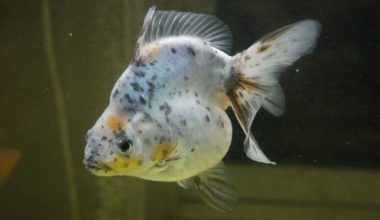
Fish can show abnormal or repetitive behavior when their environment does not meet their physical, social, or behavioral needs.
Calling that “boredom” is convenient shorthand, but the more useful question is whether the fish has enough space, structure, appropriate companions, opportunities to forage, and a stable environment.
Environmental enrichment has been associated with changes in fish behavior and welfare, but there is no universal enrichment formula for every aquarium species. Before changing the décor, always rule out water-quality problems, illness, inappropriate temperature, aggression, and overcrowding first.
Table of Contents
🎥 Watch the Video: Are Your Fish Bored?
Do Fish Really Get Bored?
“Boredom” is difficult to measure directly in fish, so it is better to focus on observable welfare and behavior.
Research has documented repetitive swimming, changes in foraging, aggression, hiding, exploration, and social behavior in response to different housing conditions. A recent guppy study, for example, found that environmental enrichment influenced behavior and welfare indicators, while broader reviews caution that enrichment does not produce identical benefits across all fish species.
So rather than assuming a fish is thinking, “I’m bored,” look for a mismatch between the animal and its environment.
A useful aquarium should allow the fish to perform behaviors that are normal for its species, such as:
- Exploring
- Foraging
- Schooling or shoaling
- Resting in cover
- Establishing territory
- Sifting substrate
- Hunting or searching for food
- Moving between open and sheltered areas
The goal is not to fill every inch of the aquarium. It is to provide meaningful options.
Behaviors That Deserve a Closer Look
No single behavior proves understimulation.
But repeated or sudden changes should trigger a closer inspection.
Repetitive Glass Swimming
Fish sometimes swim repeatedly along the glass, often called glass surfing.
Possible causes include:
- Reflections
- Stress after introduction
- Inadequate tank size
- Poor water conditions
- Territorial behavior
- Lack of cover
- Social stress
- Environmental simplicity
It would be too strong to say glass surfing automatically means boredom.
Instead, think of it as a clue.
Author Note: If ammonia and nitrite are zero, temperature is appropriate, the fish appears physically healthy, and the behavior continues for long periods, then tank layout and stocking are worth examining.
Persistent Hiding
Hiding can be completely normal.
Many species naturally retreat under wood, plants, rocks, or shaded areas, especially when resting or newly introduced.
The concern is a fish that suddenly hides almost constantly while also showing other changes such as:
- Poor appetite
- Rapid breathing
- Color loss
- Clamped fins
- Avoiding tank mates
- Unusual inactivity
Aquarium Source’s fish health guide covers physical and behavioral warning signs that should be checked before assuming the solution is simply more décor.
Aggression and Fin Nipping
A bare or poorly structured environment can sometimes contribute to aggression by providing few territorial boundaries or escape routes.
But environment is only one factor.
Aggression can also result from:
- Incompatible species
- Incorrect sex ratios
- Too few schooling fish
- Overcrowding
- Breeding behavior
- Territorial species
- Competition for food
Adding plants and sight barriers can help in some aquariums, but it cannot turn fundamentally incompatible fish into good tank mates.
Rule Out Water and Health Problems First
Behavioral changes should never make you skip the basics.
When a fish starts acting differently, check:
| Check | What to look for |
|---|---|
| Ammonia | 0 ppm |
| Nitrite | 0 ppm |
| Temperature | Appropriate and stable |
| Filter | Normal flow |
| Tank mates | Chasing or harassment |
| Fish body | Spots, swelling, wounds, clamped fins |
| Appetite | Normal interest in food |
| Breathing | No persistent gasping or rapid respiration |
A fish living in poor water does not need an enrichment toy. It needs the water-quality problem corrected.
This diagnostic order matters because abnormal swimming, hiding, and aggression are used as potential indicators of stress in fish research, but those same behaviors can have many causes.
Author Note: Once water quality, disease, and obvious compatibility problems have been ruled out, the aquarium environment becomes the next thing to evaluate.
Match Enrichment to the Fish
Different fish use their environment in very different ways.
Bettas
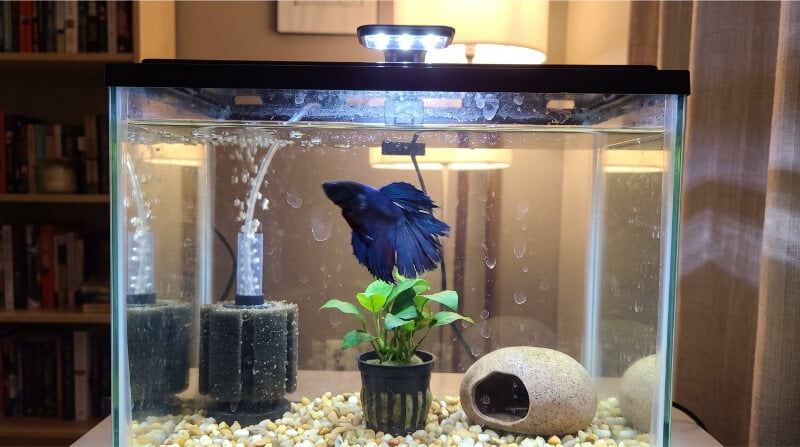
Bettas benefit from a tank that provides both open swimming space and cover near the surface.
Useful features include:
- Broad plant leaves
- Floating plants
- Driftwood
- Calm areas
- Resting spots near the surface
- Gentle flow
The betta care guide explains why tank layout, temperature, filtration, and access to the surface all matter for this species.
A bare tank may technically contain enough water, but it offers fewer opportunities for exploration and retreat.
Schooling Fish
For many schooling species, the most important enrichment is not another decoration.
It is an appropriate social group.
Tetras, rasboras, and similar fish often behave differently when kept in sufficient numbers with enough swimming space. A few individuals cannot always express the same group behavior as a proper school.
The 20-gallon setup shows how adequate group sizes and usable swimming room can matter more than simply adding more species.
Corydoras and Other Bottom Dwellers
Corydoras spend significant time foraging across the bottom.
Their environment should support that behavior with:
- Smooth sand or rounded substrate
- Open foraging areas
- Companions of the same species
- Sinking food
- Sheltered resting areas
Author Note: Structure is useful, but covering the entire substrate with rocks and decorations can remove the open bottom area they naturally use.
How to Make an Aquarium More Stimulating
You do not need to redesign the entire tank.
Start with one or two meaningful changes.
1. Add Structure
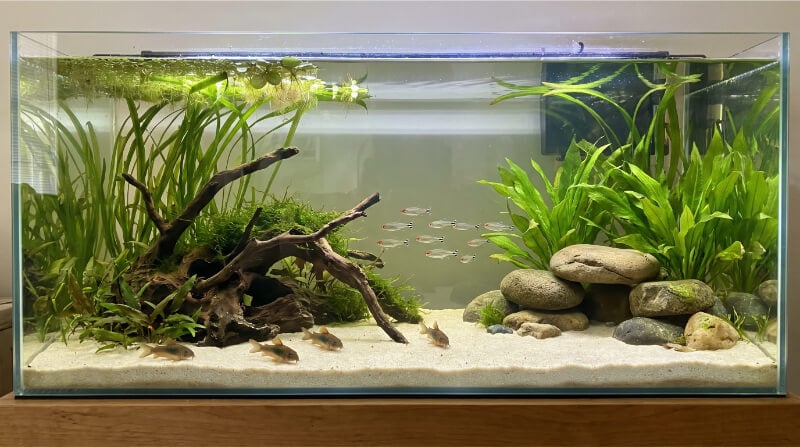
Plants, driftwood, and rocks create visual boundaries and exploration areas.
Aquarium Source’s aquascaping guide notes that plants, rocks, caves, and other structures can provide fish with hiding areas, territories, and places to explore.
A simple layout might include:
- Tall plants along the back
- One piece of branching driftwood
- A shaded cave or sheltered area
- Open swimming space in front
- Floating plants over part of the surface
Avoid turning the aquarium into a maze with no open water.
2. Provide Hiding Places Without Eliminating Open Space
Fish need options.
Shy species may benefit from caves and dense vegetation, while active schooling fish still need clear swimming room.
Floating plants can also create shaded areas that make some fish feel more secure without filling the entire tank with hardscape.
3. Improve the Social Setup
For social species, correct group size can make a larger difference than adding another plant.
Before buying more fish, confirm that:
- The aquarium is large enough
- Filtration can support the additional bioload
- You are adding the same species
- The species actually benefits from a larger group
Do not increase stocking merely because a fish is hiding.
4. Make Feeding More Natural
Food can provide behavioral stimulation too.
Instead of dropping every meal into exactly the same corner, occasionally vary the presentation while keeping portions controlled.
Depending on the species, that may include:
- Floating food
- Sinking food
- Frozen foods
- Live foods
- Food distributed across several areas
The objective is not to feed more.
It is to encourage searching and natural feeding behavior.
5. Keep Some Environmental Variety
Minor changes can give fish something new to investigate.
Examples include moving a piece of driftwood slightly, allowing plants to grow into new areas, or rotating a safe decorative item.
Avoid major rescapes every few days. Constant disruption can create stress rather than enrichment.
When More Enrichment Can Backfire
More complexity is not automatically better.
Studies have shown that enrichment effects can depend heavily on species, density, life stage, and the exact type of structure being added. In some situations, additional resources may even increase territorial competition.
Watch for:
- Increased chasing
- One fish guarding the new structure
- Reduced swimming room
- Food becoming trapped
- Dead-flow areas
- Fish unable to reach each other in a school
- Excessive territorial division
The correct environment is species-specific.
Author Note: A dense planted setup that makes a betta comfortable could reduce swimming room for an active open-water species.
A Better Way to Think About “Bored Fish”
You do not need to decide whether fish experience boredom exactly the way people do.
What matters is that fish respond to their environment, and research increasingly supports providing opportunities for species-appropriate behavior.
If something looks wrong, use this order:
- Test the water.
- Inspect the fish for illness.
- Check temperature and equipment.
- Look for aggression.
- Confirm tank size and stocking.
- Evaluate social group size.
- Review the tank’s structure and enrichment.
That sequence helps prevent a common mistake: trying to fix a genuine health problem with decorations, or trying to fix a poor environment by endlessly adjusting water chemistry.
The healthiest aquarium is not necessarily the most heavily decorated one.
It is the one that gives its inhabitants enough space, suitable companions, appropriate cover, good water quality, and opportunities to behave like the fish they are.
FAQ’s
Can aquarium fish really get bored?
Fish can show abnormal behavior in understimulating environments, although “boredom” is difficult to measure directly. Focus on space, social needs, enrichment, and health.
Why is my fish swimming against the glass?
Glass surfing can result from reflections, stress, tank size, water problems, social issues, or an overly simple environment. Test the water and check health before changing décor.
How can I enrich my fish tank?
Add species-appropriate plants, shelter, open swimming areas, proper social groups, and varied feeding opportunities. Avoid adding clutter that reduces usable space.