Fishkeeping has a lot of rules.
Some are useful. Some are outdated. And some are basically correct but become bad advice when they’re repeated without the conditions that made them useful in the first place.
The problem usually isn’t that the advice is completely false.
It’s that aquariums are biological systems, and context matters.
Here are nine common pieces of aquarium advice that deserve a little more explanation before you build a tank around them.
Table of Contents
1. “One Inch of Fish Per Gallon”
This is probably the most famous stocking shortcut in the hobby.
It’s also one of the easiest to misuse.
The rule treats fish length as though it tells you everything about:
- Body mass
- Waste production
- Swimming needs
- Territory
- Social group size
- Activity
- Adult size
It doesn’t.
Ten inches of tiny schooling fish is not remotely equivalent to one thick-bodied ten-inch fish.
Our stocking guide uses adult size, behavior, social needs, territory, and filtration rather than simply adding up inches.
Use gallon-based shortcuts only as rough warning signs.
Never use them as the final stocking decision.
2. “Change 25% of the Water Every Week”
A weekly partial water change is a perfectly reasonable starting point for many freshwater aquariums.
But 25% is not a biological law.
The amount a tank needs depends on:
- Stocking
- Feeding
- Nitrate trends
- Plant growth
- Source water
- Tank maturity
- Other water parameters
A lightly stocked planted aquarium may remain stable with a different schedule than a crowded tank full of large fish.
Instead of chasing one percentage, monitor what actually happens between changes.
Our water-change guide covers the maintenance process, but testing tells you whether your own schedule is doing enough.
The useful part of the rule is consistency.
The exact percentage should respond to the aquarium.
3. “A Bigger Filter Means You Can Keep More Fish”
Sometimes better filtration can increase the amount of waste a system processes.
That does not mean adding a huge filter magically turns a small aquarium into a large one.
Filters cannot create:
- Swimming length
- Territory
- Bottom area
- Schooling room
- Hiding space
- Compatibility
An oversized canister filter on a small aquarium is still attached to a small aquarium.
Our filter guide explains why flow, media capacity, livestock, and tank layout all matter.
Filtration is one part of stocking capacity.
It is not permission to ignore physical space.
4. “Algae Eaters Will Clean the Tank”
This one causes a lot of disappointing purchases.
Plecos, snails, shrimp, and other animals may eat certain types of algae.
That does not make them janitors.
They still:
- Produce waste
- Need appropriate food
- Have species-specific care requirements
- Eat only certain algae
- Require suitable tank conditions
A bristlenose pleco may graze surfaces, for example, but it still needs a proper diet and suitable habitat.
Buying an animal solely because you want it to clean something is backwards.
Choose the animal because you actually want to keep it.
Treat whatever cleanup it provides as a bonus.
Our algae guide is a better place to start if algae itself is the problem.
5. “Replace Your Filter Cartridge Every Month”
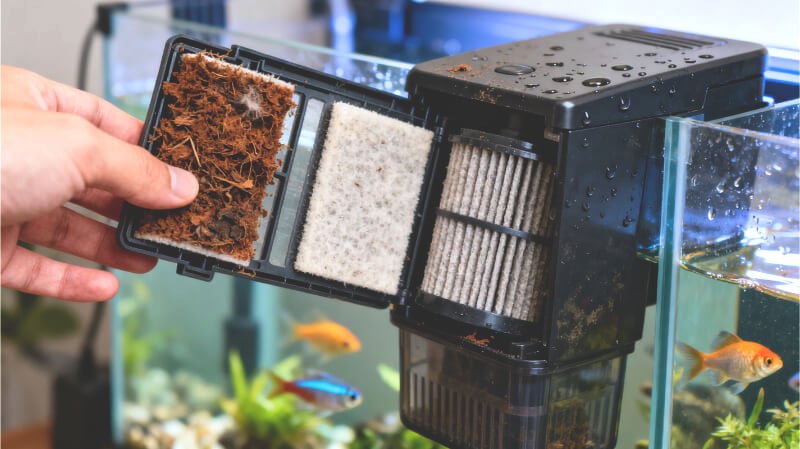
Manufacturers often recommend frequent cartridge replacement.
That makes sense from a product-sales perspective.
It does not always make sense biologically.
Filter media can hold beneficial bacteria involved in processing ammonia and nitrite.
Throwing away all established media at once can remove part of that biological community.
Instead, distinguish between:
- Disposable chemical media
- Mechanical media
- Reusable biological media
Some components genuinely need replacement.
Others can often be gently cleaned and reused.
Our nitrogen cycle guide explains why maintaining established bacterial populations matters.
The better question is not:
“Has it been 30 days?”
It’s:
“What does this particular media actually need?”
6. “The Minimum Tank Size Means the Fish Will Thrive”
Minimum tank sizes are useful.
They are also frequently misunderstood.
A gallon number cannot tell you everything about usable space.
Consider two aquariums that hold similar amounts of water:
- One is long and shallow
- One is narrow and tall
An active horizontal swimmer may strongly prefer the longer footprint.
Territorial fish also care about floor area and sightlines, not just gallons.
And schooling fish need enough space for the entire group, not just one individual.
That’s why our first aquarium guide treats tank selection as more than choosing a volume.
Think of a minimum tank size as the beginning of the evaluation.
Not the end.
7. “Peaceful Fish Can Live Together”
“Peaceful” is one of the most misleading labels in aquarium keeping.
Two species may both be peaceful and still be poor tank mates.
Why?
Their needs may conflict.
They could require different:
- Temperatures
- Water chemistry
- Flow
- Feeding
- Social groups
- Swimming zones
One may also be peaceful toward similar-sized fish while happily eating anything small enough to fit in its mouth.
Our community fish guide is useful precisely because community compatibility requires more than temperament.
“Peaceful” is one checkbox.
Not the whole compatibility test.
8. “Clear Water Means Healthy Water”
Clear aquarium water is nice to look at.
It doesn’t tell you whether ammonia or nitrite is present.
It doesn’t tell you the nitrate level.
And it doesn’t tell you whether the temperature, pH, or other parameters are appropriate for the fish.
An aquarium can look beautiful while chemistry is moving in the wrong direction.
That’s why testing matters.
Our clear-water guide covers visual clarity, but visual appearance should complement water testing rather than replace it.
Trust the fish.
Trust the test kit.
Then enjoy the clear glass.
9. “It Worked for Someone Else, So It Should Work for Me”
Personal experience is valuable in fishkeeping.
It becomes unreliable when all the surrounding conditions disappear from the story.
Someone might say:
“My betta lives with shrimp.”
“My fish never gets water changes.”
“My tank is heavily overstocked and everything is fine.”
Maybe all of those statements are true.
But you still don’t know:
- Tank size
- Filtration
- Plant mass
- Individual fish temperament
- Water chemistry
- Duration
- Maintenance
- How success was measured
This principle also matters on the publishing side of aquarium websites. Businesses may compare agencies, freelancers, marketplaces, and other link-building outsourcing options, but what worked for another publisher is not automatically the right approach for every site.
The same lesson applies to aquariums:
Results without context are anecdotes, not universal instructions.
How to Use Aquarium Rules the Right Way
The goal isn’t to ignore every rule.
Rules are useful because they give beginners somewhere to start.
Use them like this:
| Common rule | Better interpretation |
|---|---|
| 1 inch per gallon | Research the actual species |
| 25% weekly water change | Start there, then monitor the tank |
| Bigger filter = more fish | Consider space and behavior too |
| Algae eaters clean tanks | Keep them as animals, not tools |
| Replace cartridges monthly | Maintain media based on function |
| Minimum tank size | Also consider dimensions and group size |
| Peaceful = compatible | Compare all care requirements |
| Clear water = healthy | Test the water |
| It worked for someone else | Ask about the conditions |
The shortcut can point you in the right direction.
The explanation tells you when to stop following it.
The Best Aquarium Advice Usually Includes an “It Depends”
That phrase sometimes frustrates new fishkeepers.
But it’s often the most responsible answer.
A good recommendation may depend on:
- The exact species
- Adult size
- Number of fish
- Aquarium dimensions
- Water chemistry
- Temperature
- Filtration
- Plants
- Individual behavior
That doesn’t mean aquarium care has no standards.
It means the standards need to be applied to the animal and system in front of you.
The more you understand why a fishkeeping rule exists, the less likely you are to follow it when it no longer makes sense.
Frequently Asked Questions
Are aquarium rules like one inch per gallon reliable?
They can provide rough starting points, but most aquarium rules ignore important variables such as adult size, behavior, social needs, tank dimensions, and filtration.
Do I really need to change 25% of my aquarium water every week?
Not necessarily exactly 25%. Weekly partial changes are a useful baseline, but the ideal volume and frequency depend on stocking, feeding, plants, and water-quality trends.
Should aquarium filter cartridges be replaced every month?
Not automatically. Some disposable media may need replacement, while established biological media is often better maintained and reused rather than discarded on a fixed schedule.


