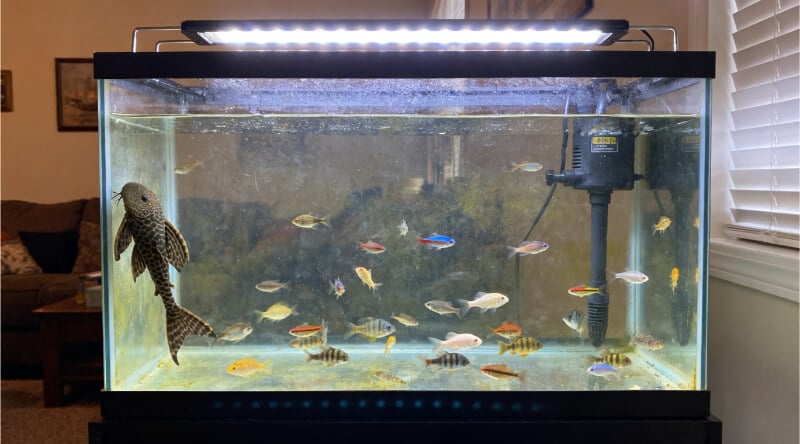
The one-inch-per-gallon rule sounds wonderfully simple: add up the adult length of your fish and keep the total below the number of gallons in the aquarium.
The problem is that aquariums do not work in inches. Two fish of the same length can have completely different body mass, activity levels, social needs, territories, oxygen demands, and waste production. That makes the rule useful only as an extremely rough historical shortcut, not as a dependable stocking method.
Table of Contents
🎥 Watch the Video: The Aquarium Rule That Doesn’t Work
What Does the One-Inch-Per-Gallon Rule Mean?
The traditional rule says an aquarium can hold roughly one inch of fish for every gallon of water.
A 20-gallon tank would therefore supposedly support about 20 inches of fish.
That sounds objective, but it immediately raises a question:
Twenty inches of what?
Twenty one-inch nano fish, two ten-inch fish, and one 20-inch fish all produce the same result on paper.
They obviously do not require the same aquarium.
The exact historical origin of the rule is difficult to pin down, but it has been repeated for decades as an easy beginner shortcut. It likely worked best when applied conservatively to small, similarly proportioned community fish.
Author Note: The trouble starts when that shortcut is treated like a biological law.
Fish Length Does Not Equal Bioload
Fish are three-dimensional animals.
Length tells you almost nothing about total body mass.
Compare:
- A slender tetra
- A deep-bodied goldfish
- A muscular cichlid
- A long, narrow loach
- A thick-bodied pleco
Two fish may both measure four inches while having very different mass, feeding habits, and waste output.
That is why our stocking guide focuses on body type, behavior, adult size, territory, and maintenance rather than adding up inches.
The contrast becomes even more obvious with a large fish.
A common pleco may reach well over a foot depending on the species sold under that trade name. It cannot be treated as equivalent to a collection of tiny schooling fish simply because their lengths add up to the same number.
Our common pleco guide lists commonly sold specimens at roughly 15 to 24 inches, which puts them in a completely different category from small community fish.
Adult Size Matters More Than Store Size
Stocking decisions should always use adult size.
The two-inch juvenile at the pet store may become:
- Four inches
- Eight inches
- A foot long
- Or considerably larger
This is where beginner stocking plans often fail.
The aquarium looks comfortably stocked for the first few months, then the fish grow while the aquarium stays the same size.
That changes:
- Waste production
- Swimming-space requirements
- Territorial behavior
- Feeding demand
- Oxygen demand
- Filter load
This is why we recommend researching adult dimensions before buying the fish, not planning around the size currently visible in the sales tank.
Author Note: A fish does not become suitable for a small aquarium simply because it has not grown yet.
Social Needs Can Break the Math Too
Some fish should not be evaluated individually at all.
A schooling or social species may need a group before its stocking requirements make sense.
For example, imagine a small schooling fish that reaches about 1.5 inches.
The one-inch rule may suggest that four individuals fit comfortably into a small aquarium.
But if the species needs a group of six, eight, or more, the meaningful question is not whether one fish fits.
It is whether the whole social group fits.
Our neon tetra care guide covers the species’ social behavior and tank requirements in more detail.
The same issue applies to many corydoras, rasboras, barbs, and other group-oriented fish.
Territory Matters as Much as Waste
Bioload is only part of stocking.
An aquarium can have excellent water quality and still be overstocked behaviorally.
Territorial fish need physical space.
Two species may occupy the same water volume but compete for exactly the same cave, bottom zone, plant thicket, or open swimming lane.
That can create:
- Chasing
- Hiding
- Fin damage
- Feeding competition
- Chronic stress
No filter can solve a territory problem.
That is why a stocking plan should ask not only, “Can the biofilter process the waste?” but also:
Can every fish use the aquarium normally?
Filtration Matters, But It Doesn’t Set the Stocking Limit by Itself
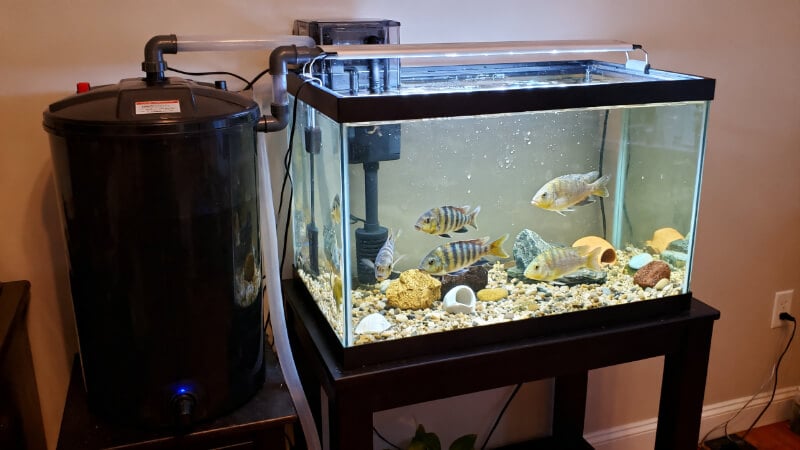
The script says filtration is the primary variable that determines how many fish an aquarium can support.
That gives filtration too much power.
A strong biological filter absolutely matters. It helps process ammonia produced by fish and other decomposing organic material.
The Merck Veterinary Manual notes that ammonia released by fish is processed by environmental bacteria through the nitrogen cycle, eventually becoming nitrite and nitrate.
But adding a larger filter does not create more:
- Swimming length
- Bottom area
- Territory
- Schooling space
- Hiding places
- Oxygen automatically
- Compatibility
You can install an oversized canister filter on a small aquarium and still have too many fish.
Our filter guide explains why filter selection should match the aquarium rather than simply choosing the largest unit available.
Water Quality Still Sets a Hard Boundary
Even when the fish appear to have enough space, stocking can overwhelm the biological system.
Fish excrete ammonia, uneaten food decomposes, and organic waste adds to the load.
A functioning biofilter converts ammonia to nitrite and then nitrate, but both ammonia and nitrite should remain undetectable in a properly functioning aquarium.
Merck’s aquarium-fish guidance specifically recommends monitoring ammonia, nitrite, and nitrate when evaluating biological filtration.
Our nitrogen cycle guide explains the same process in beginner-friendly terms.
Author Note: If stocking requires constant emergency water changes just to keep parameters acceptable, the aquarium is telling you something.
A Better Way to Decide How Many Fish You Can Keep
There is no universal replacement equation.
Instead, run every planned species through this checklist.
1. Adult Size
Research how large the fish becomes, not how large it is today.
2. Body Shape and Waste Production
A thick-bodied fish and a slender fish of equal length should not automatically count the same.
3. Social Requirements
Does the species need:
- A school?
- A shoal?
- A pair?
- To be kept singly?
Plan for the appropriate social group.
4. Swimming Space
Look at tank dimensions, not just gallons.
A long aquarium may provide much more usable space for active swimmers than a tall tank holding the same volume.
5. Territory
Ask where the fish spends most of its time.
Several species competing for the same bottom territory can create problems even if the water parameters remain excellent.
6. Compatibility
Match:
- Temperature
- Water chemistry
- Temperament
- Feeding behavior
- Adult size
7. Filtration and Maintenance
Finally, ask whether the biofilter and maintenance routine can comfortably handle the expected waste.
The goal should be stability, not finding the absolute maximum number of fish the aquarium can survive.
What This Looks Like in a 20-Gallon Tank
A good example is our 20-gallon community setup.
A practical starting plan uses:
| Fish | Number | Main zone |
|---|---|---|
| Neon tetras | 8 | Midwater |
| Small corydoras | 6 | Bottom |
| Honey gourami | 1 | Middle/upper |
That combination is not based on adding the fishes’ lengths together.
It works because the plan considers:
- Appropriate social groups
- Adult fish size
- Different swimming zones
- Peaceful temperament
- Compatible temperature needs
- Available bottom footprint
- Manageable filtration and maintenance
And even that list is a starting point, not a universal formula.
Author Note: Your source water, exact corydoras species, plants, filtration, and maintenance habits still matter.
So Is the One-Inch Rule Completely Useless?
Not completely.
If you are comparing small, similarly shaped community fish with similar care requirements, it may provide a very rough warning against obviously excessive stocking.
But once fish differ meaningfully in:
- Shape
- Adult size
- Behavior
- Social requirements
- Waste production
- Territory
- Activity
the shortcut breaks down quickly.
That’s why we would never use it as the primary stocking method.
A better question is not:
“How many inches of fish fit?”
Ask:
“Can these specific fish live normally in this specific aquarium once they’re fully grown?”
That takes slightly longer to answer.
It is also far more useful.
FAQ’s
Does the one-inch-per-gallon rule work?
Only as a very rough shortcut for similarly sized small fish. It ignores adult size, body shape, social needs, territory, waste production, and aquarium dimensions.
How should I calculate how many fish fit in my aquarium?
Evaluate adult size, social group requirements, swimming space, temperament, territory, filtration, and water quality instead of relying on one numerical formula.
Can better filtration let me keep more fish?
Better filtration can increase biological processing capacity, but it cannot create swimming room, territory, social space, or compatibility. Tank dimensions still matter.
