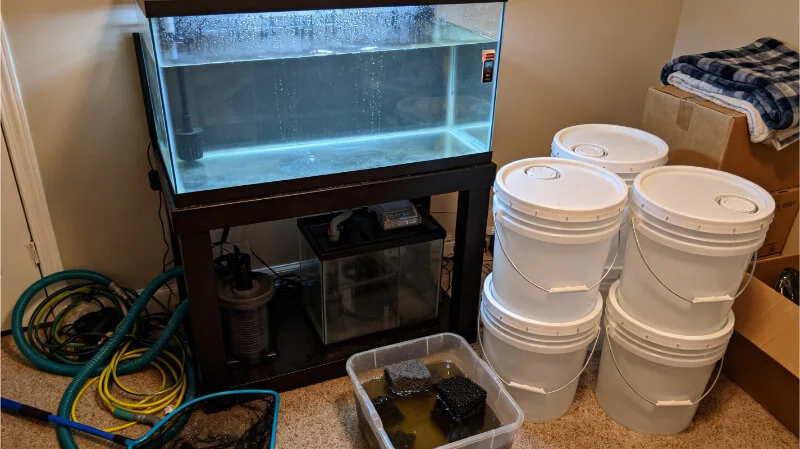
Moving a fish tank is less about saving every gallon of old water and more about protecting three things: the fish, the established biological media, and the aquarium itself.
Most of the beneficial bacteria that keep ammonia under control live on surfaces such as filter media, substrate, décor, and other wet surfaces rather than freely floating in the water. That means keeping established filter media wet and minimizing the time it sits without circulation are more important than transporting a bathtub’s worth of old aquarium water.
Table of Contents
Moving Day Checklist
| Step | Priority | Main goal |
|---|---|---|
| 1 | New location | Tank stand ready and level |
| 2 | Fish | Safe temporary containers |
| 3 | Filter media | Keep wet and protected |
| 4 | Substrate | Remove enough weight to move safely |
| 5 | Glass tank | Transport empty |
| 6 | Temperature | Avoid major swings |
| 7 | Restart | Restore heat and filtration quickly |
| 8 | Testing | Watch ammonia and nitrite |
1. Prepare the New Location Before Moving the Tank
Decide exactly where the aquarium will go before moving day.
The new spot should have:
- A strong, level stand
- Nearby electrical outlets
- Enough room behind the tank for equipment
- No prolonged direct sunlight
- Reasonable distance from heating or cooling vents
If you’re moving somewhere with different source water, test it ahead of time.
Compare the new water’s:
- pH
- KH or alkalinity
- Temperature
- Nitrate, if relevant
A major difference does not mean the move is impossible. It simply means the fish may need a more careful transition.
Our aquarium setup guide covers tank placement, leveling, equipment, and startup in more detail.
2. Stop Feeding Before the Move
Healthy adult fish generally tolerate a short fast better than they tolerate poor water inside a transport container.
Stopping food about 24 hours before a typical move can help reduce waste while the fish are temporarily living in bags, buckets, or tubs without normal filtration.
There is usually no reason to extend the fast dramatically for a short local move.
Young fish, delicate species, and animals with unusual feeding requirements may need a different plan.
3. Prepare Fish Containers Before You Start Draining
Do not wait until the aquarium is empty to figure out where the fish will go.
Useful supplies include:
- Clean food-safe buckets with lids
- Aquarium fish bags
- Insulated cooler or foam box
- Battery-powered air pump
- Airline tubing and air stones
- Fish nets
- Towels
- Water conditioner
- Thermometer
- Ammonia and nitrite tests
Author Note: Never use a bucket that previously held cleaning products, paint, chemicals, or other questionable substances.
Bags or buckets?
For a short drive, either can work.
Fish bags are easier to insulate and keep dark.
Buckets or sturdy tubs offer more water volume and make battery-powered aeration easier.
Large fish, spiny species, aggressive individuals, and species that may injure each other should be separated rather than crowded together.
There is no universal “safe number of hours” for every fish because transport risk changes with:
- Fish size
- Number of fish
- Water volume
- Temperature
- Oxygen
- Species
- Waste production
For longer trips, oxygen and temperature management become increasingly important.
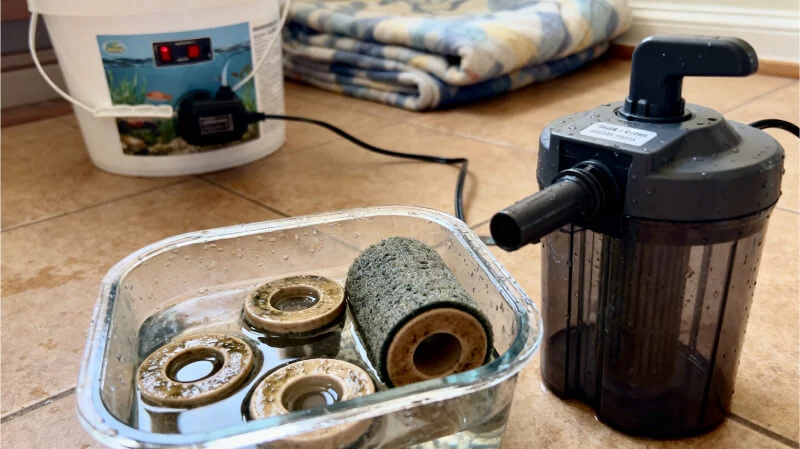
4. Preserve the Filter Media
This is the most important step for preserving the aquarium’s biological filtration.
Beneficial nitrifying bacteria colonize filter sponges, ceramic media, bio-rings, substrate, and other surfaces.
Our nitrogen cycle guide explains why those bacteria matter for converting ammonia and nitrite.
Keep established biological media:
- Wet
- Out of extreme heat or cold
- Free from untreated chlorinated water
- Out of direct sunlight
- Reinstalled as soon as reasonably possible
Aquarium Co-Op similarly recommends keeping filter media wet during maintenance because allowing it to dry can reduce the beneficial bacterial population.
For a longer interruption, aerating the container holding the media can help maintain oxygenated conditions.
Don’t clean the filter before the move
Moving day is not the time for a deep filter cleaning.
Avoid replacing all the media, sterilizing the filter, or aggressively rinsing biological media at the same time you’re already disrupting the aquarium.
Author Note: Preserve as much of the established system as practical.
5. How Much Old Aquarium Water Should You Save?
You do not need to transport 75% or 80% of the aquarium water simply to preserve the nitrogen cycle.
Very little of the biological filtration lives freely in the water column.
Saving some old water is still useful because it can:
- Hold fish during transport
- Keep filter media and plants wet
- Reduce an abrupt chemistry difference
- Make the initial refill easier
But transporting dozens of gallons creates considerable weight and spill risk without preserving much additional bacteria.
For most local moves, save what you need for livestock and wet biological material, then use properly conditioned replacement water at the new location.
If the new source water is substantially different from the old water, keeping additional tank water may help make the transition more gradual.
6. Drain and Empty the Aquarium
Aquariums are designed to hold water while sitting level and fully supported.
They are not designed to be carried around while partially full.
Before moving the tank:
- Remove the fish.
- Remove rocks and heavy décor.
- Remove most or all water.
- Remove enough substrate to make the tank safely manageable.
- Disconnect equipment.
Large rocks should never remain loose inside the aquarium during transport.
A sudden shift can damage the glass.
What about the substrate?
Keeping substrate damp is reasonable if you plan to reuse it immediately.
But you do not need to transport every grain submerged in gallons of aquarium water.
For a short move, place wet substrate in sturdy buckets or containers.
Author Note: Avoid aggressively washing established substrate immediately before the aquarium is restarted unless there is a specific reason to clean or replace it.
7. Protect the Heater, Lights, and Glass
Glass heaters deserve special care.
Turn the heater off before removing it and allow it to cool while still submerged according to the manufacturer’s instructions.
Once removed and dry, wrap fragile equipment separately.
For the aquarium itself:
- Keep it upright
- Support it evenly
- Pad the sides
- Prevent sliding
- Keep heavy objects out of it
- Do not stack boxes on top
Blankets, foam, and bubble wrap can protect the glass from impact.
Larger tanks may require multiple people, lifting equipment, or professional handling.
8. Transport the Fish With You
Fish generally belong in the climate-controlled passenger vehicle rather than inside a moving truck.
Keep containers:
- Upright
- Secure
- Away from direct sunlight
- Away from heating or AC vents
- Protected from sudden temperature swings
An insulated cooler or foam box can help stabilize temperature even when the fish themselves are inside bags.
For longer transport, battery-powered aeration can be useful in buckets or tubs.
Avoid repeatedly opening containers to check the fish unless necessary. Darkness generally reduces activity and stress during transport.
9. Set the Aquarium Up Before Unpacking Everything Else
At the new home, the fish tank should be one of the first priorities.
Start with the stand.
Make sure it is:
- Stable
- Level
- Properly positioned
- Able to support the fully filled aquarium
Then rebuild the aquarium:
- Add substrate.
- Add major hardscape.
- Add some conditioned water.
- Reinstall the filter.
- Reinstall the heater.
- Refill with temperature-appropriate conditioned water.
- Restart filtration.
- Verify temperature.
Author Note: Our first aquarium checklist covers the basic equipment worth checking before livestock goes back in.
10. Reacclimate the Fish When Needed
How much acclimation is necessary depends on how different the transport water is from the rebuilt aquarium.
Check:
- Temperature
- pH
- Salinity for saltwater systems
- Other meaningful chemistry differences
If the parameters are close after a short local move, reacclimation may be fairly simple.
If the replacement water differs substantially, transition more gradually.
Do not automatically pour dirty transport water back into the display tank.
Transport water may contain elevated waste after fish have spent hours confined in a small volume.
11. Test for Ammonia and Nitrite Early
Do not wait several days before checking whether the system survived the move.
Test ammonia and nitrite within the first day or two, then continue checking during the following days if the move was disruptive.
A preserved filter may resume functioning normally almost immediately.
A filter that:
- Dried out
- Sat without oxygen for a long period
- Lost substantial media
- Was heavily cleaned
may have lost part of its bacterial population.
That can create a temporary mini-cycle.
Watch for:
- Ammonia
- Nitrite
- Cloudy water
- Unusual fish behavior
- Reduced appetite
If ammonia or nitrite rises, respond based on the measured level rather than automatically performing one predetermined water-change percentage.
Our article on skipping water changes explains why testing and trends are more useful than relying on a universal maintenance number.
What About Feeding After the Move?
Give the fish time to settle.
For many healthy adult fish, waiting until the aquarium is running normally and the fish are behaving comfortably before offering a small meal is reasonable.
Do not compensate for the pre-move fast by feeding heavily.
Overfeeding immediately after a disruption adds waste at exactly the moment when biological filtration may be less stable.
Feed conservatively and monitor ammonia and nitrite.
Moving a Large Aquarium
The basic biology is the same.
The logistics are not.
Large tanks may require:
- Extra helpers
- Suction-cup lifters
- Dollies
- Custom padding
- Doorway measurements
- Stair planning
- Professional movers
The livestock still needs a separate transportation plan.
Green Moving, for example, states that it does not transport pets or live plants, so those would still need to travel with the owner. Its service for cross country movers in Los Angeles covers the household move itself, while the fish require their own safe transport arrangements.
The company also lists boxes, bubble wrap, furniture blankets, and specialty containers among its available packing materials.
The useful distinction is simple:
Movers can help with the empty aquarium and household equipment. They should not be assumed to handle the livestock.
Long-Distance Moves Need a Different Plan
A move across town and a two-day interstate drive should not use the same strategy.
As distance increases, you need to think more seriously about:
- Temperature control
- Oxygen
- Ammonia accumulation
- Overnight accommodations
- Whether the destination aquarium can be ready immediately
- State regulations for certain fish or aquatic species
For a very long relocation, alternatives may be safer:
- Temporary boarding through an aquarium store
- Professional livestock transport
- Shipping through an experienced fish shipper
- Rehoming particularly difficult species
Research restrictions before moving fish across state or national borders, especially species that may be regulated as invasive animals.
The First Week After the Move
The aquarium may look normal while the biological system is still settling.
For the first several days:
- Check temperature daily
- Test ammonia and nitrite
- Feed conservatively
- Watch breathing and activity
- Check the filter flow
- Avoid adding new fish
- Avoid unnecessary filter cleaning
Cloudiness after a move does not automatically mean disaster.
Substrate disturbance alone can temporarily make the water hazy.
But cloudy water combined with detectable ammonia or nitrite deserves closer attention.
Quick Moving Checklist
Before the move
- New location prepared
- Clean transport containers ready
- Fish fasted appropriately
- Battery air pump available if needed
- New source water tested
- Packing materials ready
During breakdown
- Fish secured
- Biological media kept wet
- Heavy décor removed
- Heater cooled before packing
- Tank drained
- Glass protected
At the new home
- Stand leveled
- Tank rebuilt
- Conditioned water added
- Filter restarted
- Heater restarted
- Temperature verified
- Fish reacclimated if necessary
After the move
- Ammonia tested
- Nitrite tested
- Feeding kept light
- Filter flow checked
- Fish observed
- No new livestock added immediately
Moving an Aquarium Is Mostly About Preserving Stability
The aquarium itself can be wrapped in blankets.
The harder part is preserving the living system that goes back inside it.
The safest priorities are:
- Protect the fish during transport.
- Keep established biological media wet.
- Move the aquarium empty.
- Restore filtration and temperature quickly.
- Test the water after restart.
You don’t need to move most of the old aquarium water to save the cycle.
You need to protect the surfaces where the cycle actually lives and verify afterward that the system is still processing waste properly.
FAQ’s
Do I need to save all the old aquarium water when moving?
No. Most beneficial bacteria live on filter media and other surfaces, not in the water. Save enough water for livestock and media, then refill with conditioned water.
How long can aquarium filter media stay out during a move?
Keep biological media wet and restore circulation as soon as practical. Drying and long periods without oxygen can reduce bacteria, so minimize downtime whenever possible.
Should I cycle my aquarium again after moving it?
Not automatically. If established media stays healthy, the cycle may continue normally. Test ammonia and nitrite afterward and treat any measurable spike as a mini-cycle.


