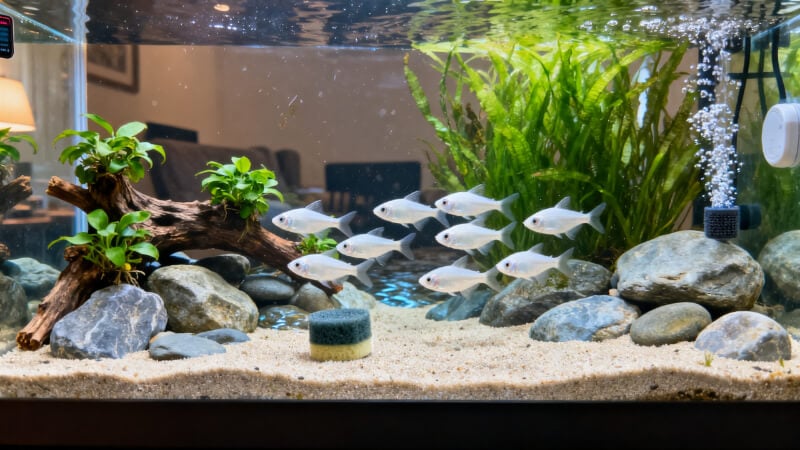
A no-heater aquarium can work beautifully when the room temperature remains within the livestock’s safe range. The best approach is not to combine every fish labeled “cold water.” It is to build the aquarium around one compatible species and monitor how warm or cold the water becomes throughout the year.
For a 20-gallon long, a school of 10 to 12 White Cloud Mountain Minnows creates a colorful, active, and manageable setup without requiring a heater under suitable indoor conditions.
Table of Contents
No-Heater Aquarium at a Glance
| Category | Practical starting point |
|---|---|
| Tank | 20-gallon long |
| Fish | 10 to 12 White Cloud Mountain Minnows |
| Temperature | Approximately 64°F to 72°F |
| Substrate | Fine sand or smooth gravel |
| Plants | Hornwort, Java fern, moss, and selected Anubias |
| Filtration | Sponge filter or adjustable HOB |
| Lighting | Start with 6 to 8 hours daily |
| Essential monitor | Reliable aquarium thermometer |
| Maintenance | Weekly observation, testing, and partial water changes |
A no-heater tank is not the same as an uncontrolled tank. Temperature still matters, and the aquarium may need cooling, heating, or a different location if seasonal conditions move outside the fish’s suitable range.
Table of Contents
- What a no-heater aquarium actually means
- Why White Cloud Mountain Minnows work
- Fish that do not fit this 20-gallon setup
- Cool-water plants and layout
- Equipment you still need
- Seasonal temperature management
- Maintenance and feeding
🎥 Watch the Video: Build a No-Heater Aquarium
What Does “No Heater” Actually Mean?
A no-heater aquarium uses the surrounding room to determine its water temperature. It does not automatically qualify as a cold-water aquarium, because a warm home can keep an unheated tank at tropical temperatures.
Before choosing fish, record the aquarium’s likely temperature at several points:
- Early morning
- Warmest part of the afternoon
- After the room’s heat or air conditioning turns off
- During the coldest part of winter
- During the hottest part of summer
Check the water itself rather than relying only on a wall thermostat. Aquarium lights, sunlight, nearby appliances, drafts, and room location can all affect the tank.
The Aquarium Source guide to cold-water aquarium fish provides additional species to research, but their temperature ranges, adult sizes, and social needs still need to overlap before they are combined.
Author Note: A heater is unnecessary only when the natural water temperature remains appropriate and reasonably stable for the selected fish.
Why White Cloud Mountain Minnows Fit This Setup
White Cloud Mountain Minnows are small, peaceful, active fish that naturally suit cooler conditions. Their metallic bodies, red fins, and bright lateral markings become particularly noticeable when they are kept in a larger group.
FishBase describes them as group-living fish and lists a minimum aquarium length of 60 centimeters, or about 24 inches. A 20-gallon long exceeds that length and provides useful horizontal swimming room.
The White Cloud Mountain Minnow’s cool-water care requirements make it a more suitable foundation than tropical tetras, bettas, or gouramis.
Recommended School Size
Keep approximately 10 to 12 minnows in the 20-gallon long rather than adding several unrelated species in small numbers.
A larger single-species group offers several advantages:
- More natural social behavior
- Stronger visual impact
- Simpler feeding
- Fewer compatibility problems
- Consistent temperature requirements
- More room for each fish to swim
White Clouds may spread out when relaxed and gather more closely when startled or excited. They should not be expected to remain in a perfectly tight school throughout the day.
Water Conditions
A practical target is approximately 64°F to 72°F. The Ornamental Aquatic Trade Association lists 17°C to 23°C, approximately 63°F to 73°F, for White Cloud Mountain Minnows. It also specifies zero ammonia, zero nitrite, and controlled nitrate.
| Parameter | Practical target |
| Temperature | About 64°F to 72°F |
| Ammonia | 0 ppm |
| Nitrite | 0 ppm |
| Nitrate | Controlled through maintenance |
| pH | Stable within a suitable moderate range |
Do not chase pH with chemicals when the source water is stable and already suitable. Sudden adjustments can create more risk than a consistent value that is slightly outside an often-quoted ideal.
Fish That Do Not Fit This 20-Gallon Build
The term “cold-water fish” covers animals with very different sizes and social requirements. Sharing a temperature range does not automatically make species compatible.
Weather Loaches
Weather loaches, also called dojo loaches, are not appropriate for this 20-gallon aquarium. They can grow to roughly 9 or 10 inches and should be maintained socially in a much larger tank with a substantial footprint.
The dojo loach’s adult size and cool-water needs make it an interesting species for a separate large aquarium, not a small bottom-dweller to add beneath minnows.
They also need:
- A secure lid
- Soft substrate
- Plenty of bottom area
- Suitable companions
- Dedicated food
- Space for a proper social group
One or two juveniles may appear to fit initially, but stocking must account for adult size and long-term behavior.
Rosy Barbs
Rosy barbs should not be kept as a pair or trio. They are active social fish that need a proper group, and adults are considerably larger and more energetic than White Cloud Mountain Minnows.
Author Note: A full rosy barb group would dominate the available space in a 20-gallon and could create fin-nipping or competition problems if cramped.
Goldfish
Goldfish also need a separate plan. They grow much larger than many buyers expect, produce substantial waste, and require stronger filtration and more swimming space than this setup provides.
A no-heater aquarium does not automatically mean a goldfish aquarium.
Plants for a Cooler Aquarium
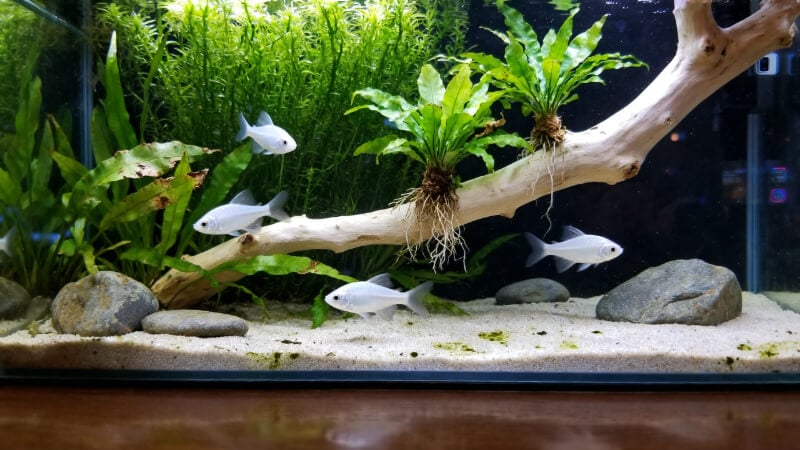
The plants should tolerate the tank’s actual temperature and lighting rather than merely survive brief exposure to cooler water.
Planting Plan
| Area | Plant choice | Purpose |
| Background | Hornwort | Fast growth and cover |
| Midground | Java fern | Structure around wood and stone |
| Hardscape | Moss | Fine texture and grazing surfaces |
| Foreground | Small Anubias, when temperatures suit it | Broad leaves and sheltered areas |
| Center | Mostly open | Swimming room |
The hornwort plant can grow floating or anchored and tolerates a broad range of aquarium conditions. Its fast growth can provide cover, but regular trimming may be necessary to stop it from shading the entire tank.
Java fern can be attached to driftwood or rock. Keep its rhizome above the substrate rather than burying it.
Anubias may tolerate the warmer end of this no-heater setup, but it is not the best choice for an aquarium that regularly falls into the low 60s. Plant performance can vary, so watch for stalled growth or deteriorating leaves.
Equipment You Still Need
Removing the heater shortens the equipment list by one item. It does not eliminate filtration, temperature monitoring, lighting, or water testing.
Essential Equipment Checklist
| Equipment | What to look for |
| Filter | Gentle to moderate circulation and reusable media |
| Thermometer | Easy-to-read and continuously visible |
| Light | Timer-compatible LED |
| Test kit | Ammonia, nitrite, nitrate, and pH |
| Conditioner | Treats chlorine or chloramine |
| Lid | Prevents jumping and limits evaporation |
| Siphon | Suitable for weekly maintenance |
Filtration
A sponge filter works well for this setup because it provides biological filtration, aeration, and moderate water movement. An adjustable hang-on-back filter is another option when stronger mechanical filtration is preferred.
A filter’s printed flow rating does not determine how many fish the tank can hold. Media capacity, stocking, maintenance, plant growth, and actual circulation matter too.
Author Note: Do not assume cooler fish produce so little waste that filtration becomes unimportant. Every fish releases ammonia and contributes organic material to the aquarium.
Lighting
Start with six to eight hours of light per day. Eight to ten hours may be excessive during the aquarium’s establishment period, especially when plant growth is still limited.
Increase the duration only when the plants need more light and algae remains manageable.
Managing Seasonal Temperature Changes
Summer heat is often a greater challenge than winter cold in an unheated aquarium. A room that stays at 68°F in January may reach 80°F in August.
Use the thermometer to track patterns rather than checking only when something appears wrong.
When the Tank Gets Too Warm
Try these measures:
- Close curtains before direct sunlight reaches the aquarium
- Increase surface movement
- Open the lid only when fish cannot jump
- Use a fan directed across the surface
- Reduce heat-producing lighting
- Move the aquarium away from windows or warm appliances
- Run room air conditioning when necessary
Fans increase evaporation, so replace evaporated water appropriately and continue monitoring temperature.
When the Tank Gets Too Cold
A no-heater plan stops being appropriate when the room regularly drives the water below the fish’s safe range.
In that situation, the responsible options are to:
- Move the aquarium to a warmer, more stable room.
- Add an adjustable heater set near the lower end of the suitable range.
- Choose livestock better suited to the actual conditions.
“No heater” should never become a rule that prevents you from protecting the fish.
Maintenance and Water Changes
Start with a weekly partial water change, then adjust the amount according to nitrate accumulation, feeding, plant growth, and measured water quality.
Weekly Routine
- Observe swimming, breathing, coloration, and appetite
- Check the minimum and maximum temperature
- Remove uneaten food and deteriorating leaves
- Test ammonia or nitrite when the aquarium is new or fish appear abnormal
- Monitor nitrate trends
- Siphon debris from accessible substrate
- Replace water with conditioned water at a similar temperature
- Confirm normal filter flow
Author Note: The replacement water should be matched closely to the aquarium temperature. Water does not need to sit for 30 minutes when it can be safely conditioned and temperature-matched before use.
Feeding
Offer small portions once or twice daily based on the food, fish condition, and amount consumed. White Clouds accept appropriately sized flakes, micro-pellets, and small frozen or live foods.
Do not use a fixed two-to-three-minute feeding rule. That can represent far too much food for a small school when concentrated pellets or flakes are used.
A better method is to add a small portion, observe consumption, and stop before food accumulates on the substrate.
Common No-Heater Aquarium Mistakes
Avoid these problems:
- Choosing fish before measuring year-round temperature
- Combining species based only on the “cold-water” label
- Keeping rosy barbs or loaches in undersized groups
- Adding weather loaches to a 20-gallon tank
- Assuming filtration is unnecessary
- Ignoring summer overheating
- Pouring much colder replacement water into the tank
- Treating an unheated aquarium as maintenance-free
The absence of a heater can simplify the setup, but simplicity comes from choosing appropriate livestock, not from removing essential care.
The Better No-Heater Blueprint
A focused White Cloud Mountain Minnow aquarium is more appropriate than combining minnows, two or three rosy barbs, and one or two weather loaches in 20 gallons.
The revised setup includes:
- One 20-gallon long aquarium
- 10 to 12 White Cloud Mountain Minnows
- Fine sand or smooth gravel
- Hornwort, Java fern, and moss
- Open central swimming room
- A sponge or adjustable HOB filter
- A reliable thermometer
- A basic LED light on a timer
- Weekly observation and water-quality management
This tank succeeds when the room provides the correct temperature. Measure the environment first, choose livestock second, and keep a heater available if seasonal conditions prove less stable than expected.
FAQ’s
Can an aquarium work without a heater?
An aquarium can work without a heater when its natural water temperature remains suitable and stable for the livestock. Monitor the tank throughout summer and winter.
What fish are best for a no-heater aquarium?
White Cloud Mountain Minnows are a strong choice for a no-heater aquarium that stays near 64°F to 72°F. Keep them in a proper school with open swimming space.
Do no-heater aquariums still need filtration?
A no-heater aquarium still needs filtration because fish produce ammonia and organic waste. A sponge filter or adjustable HOB can provide biological and mechanical support.


