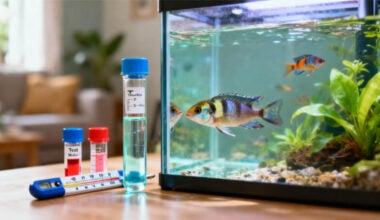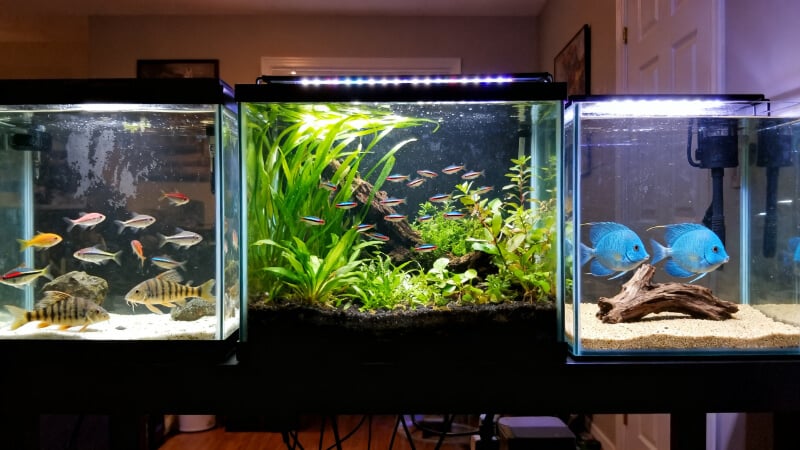
A 40-gallon breeder gives you enough room to build several genuinely different freshwater aquariums. It can become a colorful community, a plant-focused aquascape, or a warmer setup built around German blue rams.
The best choice depends on more than which fish look appealing. Your tap-water chemistry, preferred maintenance level, equipment budget, and experience should determine which direction makes sense.
Table of Contents
Three 40-Gallon Builds at a Glance
| Build | Main attraction | Experience level | Main challenge |
|---|---|---|---|
| Peaceful community | Multiple fish groups | Beginner to intermediate | Balancing compatible species |
| Planted aquascape | Plants and hardscape | Intermediate | Lighting, nutrients, and algae |
| German blue ram tank | Centerpiece cichlid behavior | Intermediate to advanced | Warmth and water quality |
These are separate stocking concepts. Do not combine every species from all three plans in one aquarium.
Table of Contents
- Why the 40-gallon breeder is so versatile
- Build one: peaceful community
- Build two: planted aquascape
- Build three: German blue ram tank
- Equipment and filtration
- How to choose the right build
🎥 Watch the Video: Three Ways to Stock a 40-Gallon
Why a 40-Gallon Breeder Is So Versatile
A standard 40-gallon breeder is approximately 36 inches long, 18 inches wide, and 16 inches tall. Its most useful feature is the 18-inch front-to-back depth.
That wider footprint provides room for:
- Open schooling lanes
- Defined fish territories
- Deep plant and hardscape arrangements
- Larger corydoras groups
- Sheltered areas away from stronger flow
- Easier separation between foreground and background
The larger volume also buffers changes better than a small desktop aquarium, although it does not make maintenance optional. Overstocking, neglected filtration, or excessive feeding can still create unsafe conditions.
Author Note: The real advantage is flexibility. You can decide whether the fish, plants, or one distinctive centerpiece species will define the aquarium.
Build One: A Peaceful Community Aquarium
This option offers the most movement and variety. The goal is to create activity at different levels of the water column while keeping temperature, temperament, and water requirements reasonably aligned.
Suggested Starting Stock
| Aquarium level | Livestock |
| Middle | 12 to 15 cardinal tetras |
| Bottom | 6 to 8 corydoras of one species |
| Upper and middle | 1 honey gourami |
A single honey gourami is a more conservative choice than a pair of dwarf gouramis. Dwarf gouramis can be territorial and are also associated with significant health concerns in commercial stock.
Cardinal Tetra School
Cardinal tetras create the strongest visual movement in this setup. Their red stripe extends farther along the body than the stripe of a neon tetra, making a large group especially noticeable against dark substrate and green plants.
The cardinal tetra’s need for stable, mature aquarium conditions is important. These fish prefer a peaceful tank with subdued areas, planted cover, and open swimming space. Aquarium Source recommends at least six, but a larger school is more appropriate for the available room in a 40-gallon breeder.
Keep the temperature and water chemistry stable rather than repeatedly adjusting them to reach a theoretical perfect number.
Corydoras Group
Add six to eight corydoras of one species rather than mixing several varieties in pairs. Suitable options may include panda, bronze, or peppered corydoras, depending on the temperature selected for the rest of the aquarium.
Corydoras need:
- Smooth sand or rounded gravel
- Dedicated sinking food
- Oxygenated water
- Open substrate for foraging
- Companions of their own species
They may consume food that reaches the bottom, but they are not a cleanup system. Their waste still contributes to the aquarium’s bioload.
One Honey Gourami
One honey gourami adds a recognizable centerpiece without placing two territorial gouramis in limited space. Provide floating cover, calm planted areas, and open access to the surface.
Author Note: This community is best for someone who wants color and steady movement without turning the aquarium into a highly technical project.
Build Two: A Plant-Focused Aquascape
In this build, plants and hardscape become the main attraction. Fish add movement, but they do not dominate the design.
Suggested Starting Stock
| Livestock | Suggested number |
| Ember tetras | 15 to 20 |
| Neocaridina shrimp | 10 to 20 |
| Optional nerite snails | 1 to 3 |
The exact shrimp population may grow over time if conditions support reproduction.
Build the Layout in Layers
A planted aquascape normally uses different plant heights to create depth.
| Area | Plant examples |
| Foreground | Dwarf hairgrass, Monte Carlo, or Staurogyne repens |
| Midground | Cryptocoryne, Anubias, or compact ferns |
| Background | Rotala, Ludwigia, Bacopa, or Vallisneria |
| Hardscape | Mosses attached to wood or stone |
Nutrient-rich aquasoil can support rooted plants, but it is not mandatory for every planted aquarium. Sand or gravel can also work with root tabs and suitable plant selection.
Decide Between Low-Tech and CO2
A low-tech planted aquarium uses moderate lighting, slower-growing plants, and no injected carbon dioxide. It usually costs less and requires fewer adjustments.
A higher-energy aquascape may use stronger lighting, regular fertilization, and pressurized CO2. The CO2 system should match the plants and lighting level, not be added simply because the tank contains live plants. Carpet plants and demanding stems often benefit substantially, while Java fern and Anubias do not require injection.
| Low-tech approach | CO2-injected approach |
| Lower equipment cost | Faster plant growth |
| Simpler daily operation | Wider plant selection |
| Easier for beginners | More trimming and monitoring |
| Slower layout development | Greater risk of imbalance |
Author Note: Injected CO2 must be consistent. Too little may limit growth, while excessive levels can endanger fish and shrimp.
Ember Tetras and Shrimp
The small size and planted-tank suitability of ember tetras make them useful supporting fish. Their orange coloration contrasts with green vegetation, and a larger group creates movement without overwhelming the design.
Neocaridina shrimp graze on biofilm, soft algae, and organic material across plants and hardscape. However, they still need stable water and appropriate food.
Adult shrimp may coexist with ember tetras, but newly hatched shrimplets can be eaten. Dense moss and fine-leaved plants improve their chances of survival.
The cherry shrimp care guide explains their feeding and breeding needs and can help readers decide whether a mixed fish-and-shrimp aquascape is appropriate.
Build Three: A Warm German Blue Ram Aquarium
This build focuses on individual fish behavior rather than maximum species variety. German blue rams are small cichlids, but they are more demanding than their size suggests.
They need consistently warm water, excellent water quality, and tank mates that tolerate the same conditions.
Suggested Starting Stock
| Livestock | Suggested number |
| German blue rams | 1 established pair or 1 individual |
| Rummy-nose tetras | 12 to 15 |
| Bristlenose pleco | 1, with caution |
A bonded or compatible pair is preferable to purchasing two random rams and assuming they will coexist. Two fish that do not accept each other may fight despite the available space.
Rams Need a Specialized Environment
The German blue ram requires warm, stable, high-quality water and is better suited to an established aquarium than a newly cycled setup. Aquarium Source lists rummy-nose tetras and bristlenose plecos among potential tank mates, but compatibility still depends on individual behavior and environmental overlap.
A practical ram environment includes:
- Temperature around 82°F or slightly higher
- Fine sand
- Flat stones and sheltered spawning areas
- Plants that tolerate warm water
- Gentle to moderate circulation
- Low ammonia and nitrite
- Consistently controlled nitrate
German blue rams naturally occur in warm, acidic waters and can become territorial when breeding.
Rummy-Nose Tetras
Rummy-nose tetras are useful dither fish because they stay active in open water and generally occupy a different zone from the rams.
The rummy-nose tetra’s active schooling behavior works best in a proper group with open swimming room. Their coloration can also provide an early visual clue when stress or water quality is affecting the school.
Is a Bristlenose Pleco a Good Addition?
A bristlenose pleco remains much smaller than a common pleco and can fit physically in a 40-gallon aquarium. The bristlenose pleco still needs dedicated food and driftwood, however, and should not be added merely to remove algae.
This combination requires careful consideration because the pleco and rams may use overlapping bottom territory. The pleco also produces substantial waste relative to the tetras.
Author Note: An alternative is to keep only the rams and rummy-nose school, leaving more territory and reducing the bottom-level bioload.
Equipment and Filtration
Any of the three builds needs reliable filtration, heating, lighting, and testing. The exact equipment should match the aquarium’s purpose.
| Equipment | Community | Aquascape | Ram tank |
| Filtration | HOB, sponge, or canister | Canister or discreet HOB | Mature filter with stable flow |
| Heating | Standard tropical range | Based on livestock | Strong, reliable warm-water heating |
| Lighting | Moderate | Plant-specific | Moderate and plant-compatible |
| CO2 | Not required | Optional or recommended for demanding plants | Usually unnecessary |
| Test kit | Essential | Essential | Especially important |
A canister filter is useful when you want high media capacity and unobtrusive equipment, but it is not mandatory simply because the aquarium holds 40 gallons.
A large hang-on-back filter, dual sponge filters, or another properly maintained system may also work. Flow should circulate the aquarium without exhausting fish or leaving major dead zones.
Which 40-Gallon Setup Fits You?
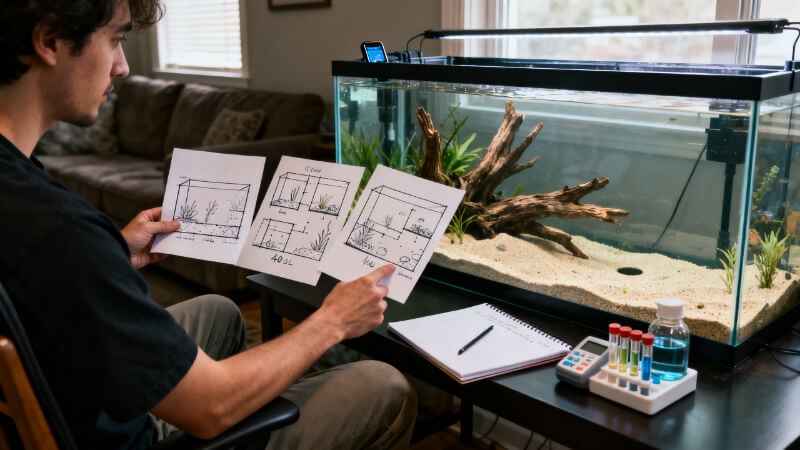
Choose the peaceful community when you want:
- Multiple species
- Constant visible movement
- Straightforward plants
- Moderate maintenance
- A forgiving introduction to larger aquariums
Choose the planted aquascape when you enjoy:
- Designing layouts
- Growing and trimming plants
- Experimenting with light and nutrients
- Watching subtle shrimp behavior
- Treating the aquarium as a living display
Choose the ram aquarium when you are prepared for:
- Warmer water
- More demanding fish
- Careful tank-mate selection
- Close water-quality monitoring
- Territorial or breeding behavior
The 40-gallon breeder does not remove every stocking limitation. What it provides is enough space to make a real design choice.
Pick one direction, build the environment around its most demanding inhabitant, and resist the temptation to combine every appealing idea into one tank.
FAQ’s
What is the best way to stock a 40-gallon aquarium?
A 40-gallon breeder works well for a community, planted aquascape, or warm ram setup. The best choice depends on your water, budget, experience, and maintenance goals.
Can cardinal tetras live in a 40-gallon tank?
Cardinal tetras can live in a 40-gallon community when kept in a proper school with peaceful tank mates, stable warm water, subdued areas, and open swimming room.
Can German blue rams live in a 40-gallon tank?
German blue rams can live in a 40-gallon, but they need very warm, clean water and carefully selected tank mates. They are better suited to experienced aquarium keepers.