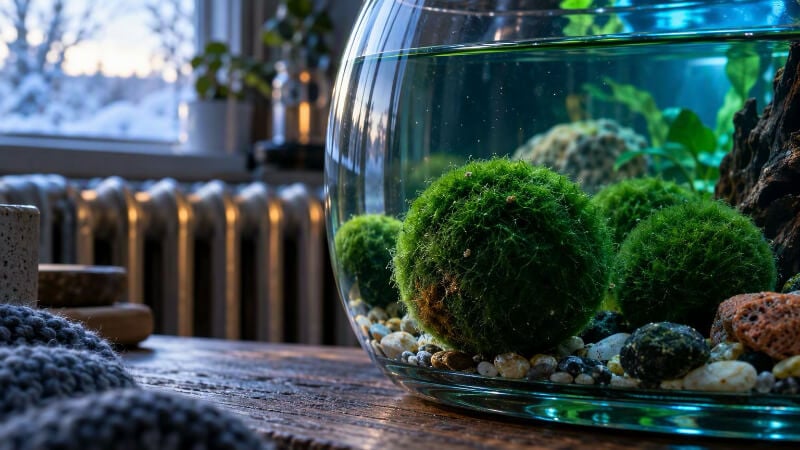
Marimo moss balls are not actually moss. They are spherical growth forms of the freshwater green alga Aegagropila linnaei. Their care is fairly simple, but browning usually means something in the environment deserves attention.
For beginners, the priorities are straightforward: keep the water reasonably cool, avoid intense direct light, refresh the water, remove trapped debris, and rotate the marimo periodically.
Table of Contents
Quick Marimo Care Checklist
| Care factor | What to aim for | Warning sign | First response |
|---|---|---|---|
| Temperature | Cool, stable freshwater | Browning after heat exposure | Move to a cooler location |
| Light | Bright to moderate indirect light | Pale or brown exposed side | Reduce direct light |
| Water | Fresh, clear water | Cloudiness or odor | Replace water |
| Cleaning | Gentle rinsing as needed | Debris in filaments | Swish gently underwater |
| Rotation | Periodic turning | Flat or brown underside | Reorient and roll gently |
| Submersion | Fully underwater | Exposed upper surface | Top up water |
| Space | Water around each ball | Flattened contact areas | Use a wider container |
| Vessel | Clean glass and bottom | Film or sediment | Wipe with plain water |
| Air exchange | Avoid stale sealed setups | Surface film or odor | Open and refresh |
| Stability | Avoid rapid hot/cold shifts | Change after relocation | Stabilize temperature |
| Inspection | Check regularly | New brown patches | Correct conditions early |
1. Keep the Water Cool and Stable
Marimo naturally occur in cool freshwater environments, and temperature matters.
Research on giant marimo in Lake Akan found that water temperature strongly influences growth and decomposition, with laboratory work cited in the study showing filamentous marimo growing well around 22°C, or about 72°F. That does not mean 72°F is a universal household target, but it supports keeping marimo away from prolonged heat.
For home care, focus less on chasing one exact number and more on avoiding:
- Hot windowsills
- Radiators
- Heating vents
- Warm equipment
- Small containers that heat quickly
A simple aquarium thermometer makes it easier to notice whether the water is warmer than expected.
If you’re starting from scratch, this beginner marimo care guide provides another basic care reference to compare with your setup.
2. Use Gentle Indirect Light
Marimo photosynthesize, so they need light.
They do not need intense direct sunlight.
A laboratory study found that prolonged high-light exposure can damage marimo photosystems, especially under certain temperature conditions.
A good home location provides enough ambient or aquarium light to keep the algae photosynthesizing without placing the container in direct afternoon sun.
Direct sun creates two problems at once:
- Stronger light exposure
- Rapid warming of the water
If the side facing a window begins to look pale, yellow-green, or brown, move the vessel farther from the glass rather than covering it with a cloth.
Our low-light plants guide also includes marimo and several other freshwater options that do not need intense lighting.
3. Refresh the Water Regularly
A marimo-only jar has very little water volume.
That means debris and dissolved material become concentrated more quickly than they would in a larger aquarium.
For a simple marimo display, refreshing the water periodically is a reasonable maintenance habit. There is no need to obsess over one universal schedule, though.
Change it sooner when you notice:
- Cloudiness
- Odor
- Visible debris
- Film on the container
- Unusually warm water
Use clean freshwater appropriate for the setup.
If the marimo lives inside a stocked aquarium, follow the aquarium’s normal water-change routine rather than removing and replacing all of the tank water just for the marimo.
Author Note: Our guide to skipping water changes explains why water quality should be judged by the system rather than by a rigid percentage.
4. Rinse Away Trapped Debris
Marimo filaments can catch fine particles.
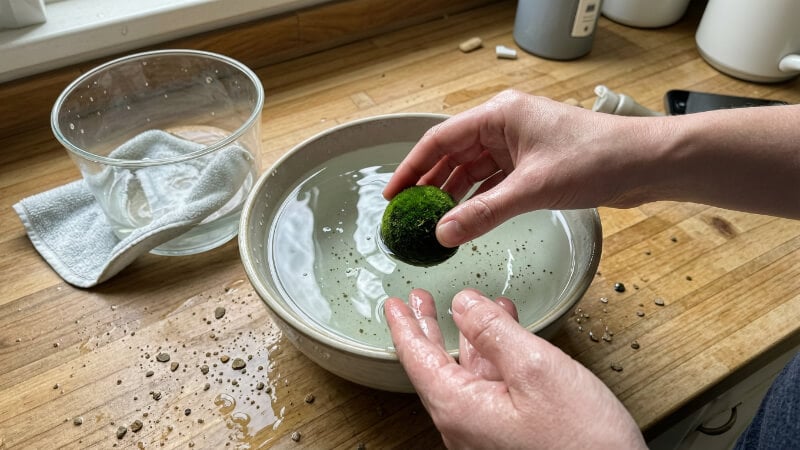
During a water change, place the ball in clean, cool water and gently swish it.
If debris remains trapped inside, a very light squeeze underwater can help release it.
Avoid:
- Wringing
- Twisting
- Scrubbing
- Pulling the filaments apart
The goal is to remove debris without damaging the structure.
A marimo should feel like a living algal colony, not something that needs to be scrubbed clean.
5. Rotate the Marimo
In the wild, water movement helps marimo roll and maintain their rounded form.
A marimo sitting motionless in a jar may spend weeks resting on the same surface.
Periodically turning it helps prevent one side from staying permanently shaded or compressed.
During maintenance:
- Inspect the underside.
- Rinse gently if needed.
- Roll the ball lightly between wet palms.
- Return it in a different orientation.
Do not try to compress it into a perfectly hard sphere.
A slightly irregular marimo is normal.
6. Keep It Fully Submerged
Marimo are aquatic algae and should remain underwater.
In a shallow container, evaporation may expose the top before you notice.
Top up with appropriate freshwater as needed.
A marimo can sometimes float temporarily because gases become trapped within its filaments. Floating alone does not mean it is dying.
Author Note: If needed, gently squeeze it underwater to release trapped air and let it resettle naturally.
7. Give Each Ball Enough Space
You do not need a huge container.
But several marimo packed tightly together can create contact points where:
- Debris accumulates
- One side remains shaded
- The shape flattens
- Inspection becomes difficult
A practical rule is simply to leave enough room that each marimo can be turned without scraping constantly against the glass or another ball.
This becomes more important as the marimo grows.
8. Keep the Vessel Clean
The container itself can accumulate film and sediment.
During a full vessel cleaning, temporarily place the marimo in prepared freshwater and wipe the empty container with plain water and an aquarium-safe pad or cloth.
Avoid household cleaners.
Even trace residues from:
- Soap
- Glass cleaner
- Disinfectants
- Fragranced sprays
have no place in a marimo or aquarium vessel.
Author Note: The same basic principle applies when preparing aquarium décor and equipment: clean does not mean chemically sterilized.
9. Avoid Stagnant Sealed Containers
Marimo are sometimes sold in decorative jars with lids.
A loosely covered display is different from permanently sealing the organism into stagnant water.
If you use a closed decorative container, open it periodically during maintenance and refresh the water rather than treating it like a permanently sealed ecosystem.
A stale odor, unusual surface film, or cloudy water is a reason to clean and refresh the setup.
Do not blame every brown patch on a lid, though.
Temperature, light, debris, and prolonged contact with one surface are more useful things to investigate first.
10. Prevent Sudden Temperature Changes
Cool water is useful.
Temperature shock is not.
Do not move a marimo directly from unusually warm water into ice-cold water just because you noticed browning.
Instead:
- Move the container away from the heat source
- Allow conditions to stabilize
- Measure the actual water temperature
- Make normal water changes with appropriately cool water
Author Note: Consistency matters more than dramatic corrections.
11. Inspect Brown Patches Early
Browning is a symptom, not a diagnosis.
When you first notice a patch, check the obvious environmental factors:
- Has the water been unusually warm?
- Is the container receiving direct sunlight?
- Has one side remained pressed against the bottom?
- Is debris trapped in the filaments?
- Has the water become cloudy or stale?
Correct the likely cause and monitor the same area during later inspections.
Avoid immediately adding fertilizers, medications, salt, or other products simply because the color changed.
What to Do If Your Marimo Is Already Brown
Start conservatively.
Move it away from direct sunlight, verify the water temperature, refresh stale water, and gently clean away debris.
Then give it time.
Because marimo grow slowly, recovery will not necessarily be obvious in a day or two.
If the affected area is soft, decomposing, foul-smelling, or continuing to spread despite corrected conditions, the problem may be more advanced than simple light or temperature stress.
At that point, separate the marimo from other specimens while you assess it.
Important: Check New Marimo for Zebra Mussels
This deserves a separate note, particularly for U.S. readers.
Marimo sold through the aquarium trade have previously carried invasive zebra mussels. U.S. Fish & Wildlife Service reports that contaminated moss balls were found across numerous states beginning in 2021 and continues to advise buyers to verify the origin of marimo and inspect newly purchased specimens.
If you find a suspicious attached mussel, do not:
- Put the marimo into another aquarium
- Flush it
- Dump its water outdoors
- Release it into a pond, stream, or drain
Follow current federal and state guidance for disposal and reporting instead. U.S. Fish & Wildlife Service specifically warns against releasing contaminated moss balls or associated water into natural waterways.
Author Note: This has nothing to do with browning, but it is an important part of buying and handling marimo responsibly.
The Four Things to Check First
If your marimo starts turning brown, don’t make eleven changes at once.
Start with these four:
- Temperature: Has the water become too warm?
- Light: Is it getting direct or overly intense light?
- Cleanliness: Is debris trapped in the ball or vessel?
- Position: Has the same side remained shaded or compressed?
Those checks solve the most obvious husbandry problems without turning a simple marimo setup into a chemistry experiment.
Marimo care is supposed to be simple.
Keep the water stable, keep the light gentle, clean the ball occasionally, and give every side a chance to receive light.
FAQ’s
Why is my marimo moss ball turning brown?
Browning can follow excess heat, overly intense light, trapped debris, stale water, or one side staying compressed. Check conditions before adding treatments.
How much light does a marimo moss ball need?
Marimo generally do well with gentle indirect or moderate aquarium light. Avoid prolonged direct sunlight because it can increase both light stress and water temperature.
How often should I clean a marimo moss ball?
Clean it when debris accumulates or during routine water changes. Swish it gently in clean freshwater and roll it lightly rather than scrubbing or wringing it.


