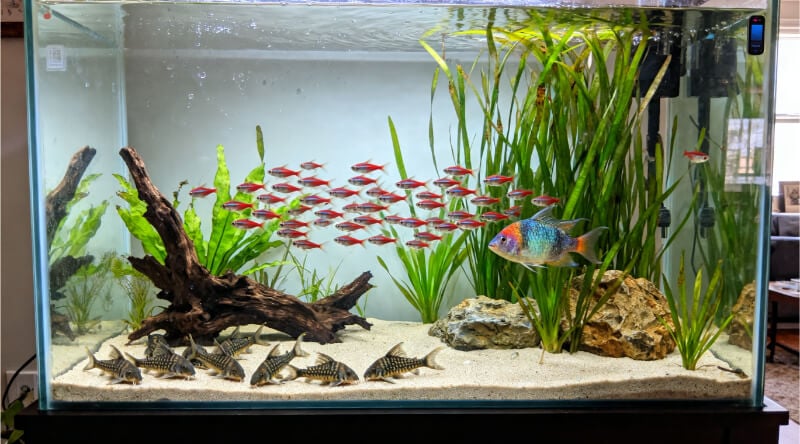
A 55-gallon aquarium gives you something smaller tanks cannot: enough horizontal swimming room to build around a substantial school of fish while still leaving space for a centerpiece species and an active bottom group.
For most community setups, the best approach is not filling the tank with as many species as possible. Choose one large school, one centerpiece option, and one compatible bottom group, then build around their shared temperature, temperament, and water requirements.
Quick Picks
| Role | Best choices |
|---|---|
| Colorful school | Cardinal tetra |
| Tight schooling | Rummy nose tetra |
| Easier community school | Harlequin rasbora |
| Centerpiece | Angelfish |
| Warm-water centerpiece | German blue ram |
| Bottom group | Sterbai cory |
| Compact pleco | Bristlenose pleco |
| Peaceful alternative | Pearl gourami |
Table of Contents
🎥 Watch the Video: Best Fish for a 55-Gallon Tank
Why a 55-Gallon Tank Changes Your Options
A standard 55-gallon aquarium is typically about four feet long.
That horizontal length matters more than the gallon number alone because active schooling fish, territorial species, and larger centerpiece fish use space, not a number printed on the aquarium box.
A 55 also gives you enough room to make one school visually impressive rather than maintaining several undersized groups.
That is the approach we prefer here.
1. Cardinal Tetra
Cardinal tetras are one of the strongest choices if you want the aquarium to feel active without using large fish.
FishBase lists Paracheirodon axelrodi at around 3 cm standard length and notes that it naturally occurs in shoals in the middle water layers.
In a 55-gallon, that small body size lets you keep a visually meaningful group without dominating the tank’s bioload.
A group of roughly 15 to 20 creates a much stronger effect than scattering several small schools around the aquarium.
Our cardinal tetra guide covers their water requirements and care in more detail.
Best for
- Planted community tanks
- Larger schools
- Soft to moderately soft water
- Tanks without predatory centerpiece fish
2. Rummy Nose Tetra
If movement matters more than individual color, rummy nose tetras may be even better.
They are well known for staying relatively close together compared with many other aquarium tetras, particularly when moving through open water.
Our rummy nose tetra guide recommends groups of at least six, but a 55-gallon gives you enough room to make the group substantially larger.
A school of 15 to 20 is a practical starting point when the rest of the stocking plan is conservative.
They prefer stable conditions, so we would choose them for an established aquarium rather than a tank that was filled yesterday.
3. Harlequin Rasbora
Harlequin rasboras are an excellent option when you want a peaceful school without making the aquarium extremely specialized.
They reach around two inches in captivity and have the distinctive copper-orange body and dark wedge-shaped marking that makes a larger group easy to notice. Our harlequin rasbora guide lists them as peaceful schooling fish.
One correction from the video script is worth making here.
FishBase gives their natural pH range as roughly 5.0–7.0 and temperature around 72–77°F, so we would not pitch them specifically as a hard-water alternative to cardinal tetras.
Their advantage is primarily adaptability in typical captive community setups, not an inherent preference for hard alkaline water.
4. Angelfish
A 55-gallon finally gives freshwater angelfish useful vertical and horizontal room.
That makes them one of the more obvious centerpiece candidates.
But there are two caveats.
First, mature angelfish are cichlids. Individuals can become territorial, especially when breeding.
Second, sufficiently small tank mates may eventually be viewed as food.
For that reason, we would generally build a community around one angelfish unless you specifically want to manage a compatible pair and their breeding behavior.
Better tank mates include
- Medium-sized peaceful schooling fish
- Corydoras
- Suitable larger rasboras
- Other species too large to be swallowed
Tiny tetras are more questionable once the angelfish reaches full size.
5. German Blue Ram
For a smaller cichlid centerpiece, German blue rams offer another direction entirely.
They stay much smaller than angelfish but still give you classic cichlid behaviors: territory, interaction, pair formation, and breeding displays.
Our German blue ram guide covers the species in detail.
The biggest consideration is temperature.
Rams generally do best toward the warmer end of tropical aquarium conditions, so the rest of the community needs to be selected accordingly.
A confirmed pair can work in a 55-gallon with enough structure and clearly defined territories, but adding two random rams does not guarantee they will become a peaceful pair.
6. Sterbai Cory
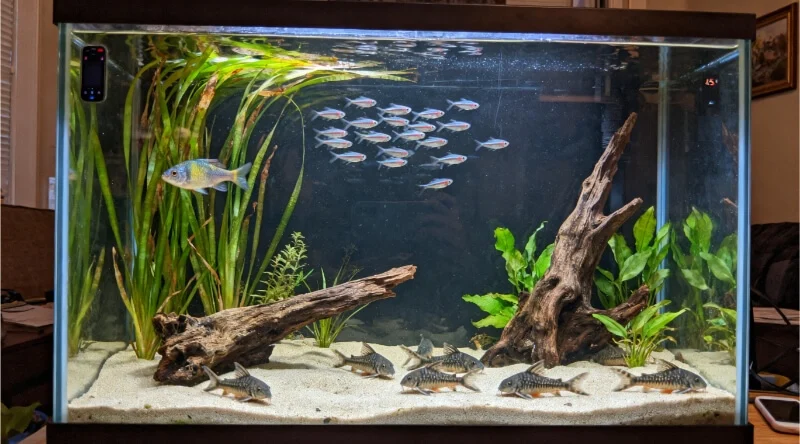
The bottom of a 55-gallon is large enough to make a proper corydoras group worthwhile.
Sterbai corys are especially useful when the tank is being kept warmer for species such as rams.
Our Sterbai cory guide recommends keeping them in a group rather than individually.
For a 55-gallon, 8 to 10 Sterbai corys can create a much more natural bottom layer than two or three isolated specimens.
Give them:
- Smooth sand or rounded substrate
- Open foraging areas
- Shaded resting areas
- Sinking food
- Companions of the same species
They are not cleanup equipment. They are social fish that happen to forage on the substrate.
7. Bristlenose Pleco
If you want a pleco in a 55-gallon, bristlenose is a much more practical choice than a common pleco.
Our bristlenose pleco guide lists adults around three to four inches, which keeps them manageable in a tank this size.
They will graze algae and biofilm, but don’t make the mistake of treating that as their entire diet.
Provide:
- Appropriate sinking food
- Vegetable matter
- Driftwood and shelter
- Good bottom access
One bristlenose is enough for most 55-gallon community plans.
8. Pearl Gourami
Pearl gouramis are worth including because not every 55-gallon needs a cichlid centerpiece.
A pearl gourami provides a slower, more deliberate presence in the upper and middle zones and can work well with peaceful schooling species.
They also create a different visual balance than angelfish or rams.
This is the option we would consider when you want:
- A peaceful centerpiece
- Larger schooling fish
- Planted cover
- Moderate flow
- A traditional community setup
As with any gourami, individual temperament still matters.
Three Fish We Would Skip in a 55-Gallon
A 55-gallon looks large enough that some oversized species become very tempting.
That does not mean they belong there.
Tinfoil Barb
Tinfoil barbs can reach about 35 cm, or roughly 14 inches.
They are also active group-oriented fish.
A four-foot 55-gallon simply does not provide enough long-term room for a proper group of adults.
Clown Loach
Clown loaches are especially deceptive because they are usually sold small.
FishBase lists a maximum size around 30.5 cm, approximately 12 inches, and specifically notes aquarium keeping in groups of five or more with a minimum aquarium length of 150 cm.
A 55-gallon is only about 122 cm long.
That makes it unsuitable as a permanent home for a mature group.
Oscar
Oscars create perhaps the strongest temptation because one juvenile can look perfectly comfortable in a 55.
FishBase reports Astronotus ocellatus reaching substantially larger sizes, including a published maximum of 45.7 cm.
We would start with at least a 75-gallon for one adult Oscar rather than planning to upgrade after the fish grows.
Three Practical 55-Gallon Stocking Ideas
Instead of one “perfect” combination, choose a direction.
Option 1: Classic Community
| Zone | Fish |
|---|---|
| Midwater | 15–20 harlequin rasboras |
| Bottom | 8 Sterbai corys |
| Centerpiece | 1 pearl gourami |
| Optional | 1 bristlenose pleco |
This is the easiest of the three to build around.
Option 2: Warm South American Community
| Zone | Fish |
|---|---|
| Midwater | 15–20 cardinal or rummy nose tetras |
| Bottom | 8 Sterbai corys |
| Centerpiece | 1 established pair of German blue rams |
Keep temperature and water chemistry appropriate for the rams and verify that all species are comfortable at the same target temperature.
Option 3: Angelfish Community
| Zone | Fish |
|---|---|
| Centerpiece | 1 angelfish |
| Midwater | One school of appropriately sized peaceful fish |
| Bottom | 8 corydoras |
| Optional | 1 bristlenose pleco |
Avoid tiny tank mates that may eventually fit in the angelfish’s mouth.
Don’t Stock by Gallons Alone
A 55-gallon gives you more options, but the same stocking principles still apply.
Before combining species, compare:
- Adult size
- Group requirements
- Temperature
- Water chemistry
- Temperament
- Swimming zone
- Territory
- Filtration and maintenance
Our recent stocking guide explains why simple gallon-based rules cannot capture all of those variables.
The goal is not to use every available gallon.
It is to create a community where each species can behave normally without requiring constant intervention to keep the tank stable.
FAQ’s
How many fish can you put in a 55-gallon tank?
There is no fixed number. Adult size, schooling needs, behavior, territory, filtration, and swimming space matter more than simply calculating fish per gallon.
What is the best centerpiece fish for a 55-gallon tank?
Angelfish, German blue rams, and pearl gouramis can all work. The best choice depends on temperature, tank mates, temperament, and the type of community you want.
Can an Oscar live in a 55-gallon tank?
A juvenile may physically fit, but a 55-gallon is too restrictive as a permanent home for an adult Oscar. We recommend planning around at least a 75-gallon tank.
