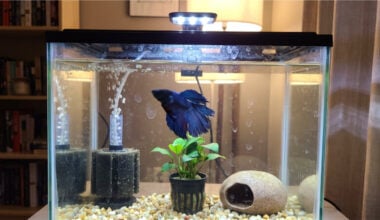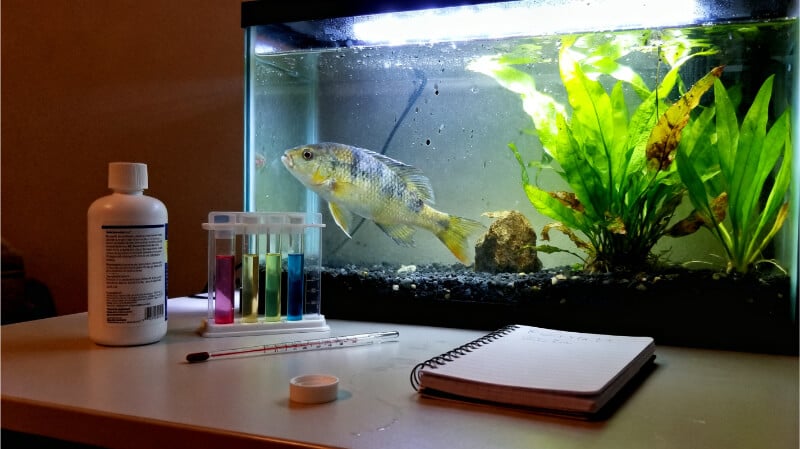
Seeing a fish suddenly hide, stop eating, clamp its fins, or develop an unusual mark creates a strong temptation to reach for medication immediately.
Sometimes medication is exactly what the fish needs.
But many apparent fish-health problems begin with water quality, temperature, injury, aggression, or another environmental issue. Treating before checking those basics can expose the fish to unnecessary medication while leaving the real problem untouched.
Before adding anything to the aquarium, work through these nine checks.
Table of Contents
- Test the water first
- Check the temperature
- Look at the whole fish
- Don’t diagnose from one symptom
- Calculate the actual water volume
- Read the treatment instructions completely
- Check what your filter contains
- Consider a hospital tank
- Keep aquarium medication separate from other pet medicines
1. Test the Water First
Before assuming disease, test the aquarium.
At minimum, check:
- Ammonia
- Nitrite
- Nitrate
- pH
- Temperature
Ammonia or nitrite can cause lethargy, rapid breathing, clamped fins, poor appetite, and other symptoms that can easily be mistaken for infection.
A medication will not fix an uncycled or unstable aquarium.
Our fish health guide recommends looking at environmental conditions alongside physical symptoms rather than diagnosing from behavior alone.
Author Note: If ammonia or nitrite is detectable, correcting the water-quality problem may be the most urgent intervention.
2. Check the Temperature
Temperature changes can create surprisingly dramatic behavioral changes.
A tropical fish kept too cold may:
- Become lethargic
- Stop eating
- Sit near the bottom
- Move more slowly
- Become more vulnerable to health problems
Excessive heat creates a different set of problems, including increased metabolic demand and reduced dissolved oxygen.
Before treating a fish that suddenly seems “off,” verify the temperature with a reliable thermometer rather than assuming the heater is working correctly.
The target temperature depends on the species.
A betta, goldfish, White Cloud Mountain Minnow, and discus should not all be managed using the same temperature recommendation.
3. Look at the Whole Fish
One symptom rarely tells the entire story.
Take a few minutes to observe:
- Fins
- Gills
- Eyes
- Abdomen
- Scales
- Skin
- Mouth
- Swimming
- Breathing
- Appetite
Also look at the other fish.
If several animals suddenly show similar symptoms, an environmental issue or contagious condition becomes more plausible than an isolated injury.
Author Note: If only one fish is affected, consider whether aggression, trauma, age, or an individual health problem could be involved.
4. Don’t Diagnose From One Symptom
White spots do not automatically mean every possible parasite.
A damaged fin does not automatically mean bacterial fin rot.
Bottom sitting does not automatically mean disease.
Even a symptom such as clamped fins can occur with poor water quality, stress, temperature problems, or illness.
Our fin rot guide is a good example. Damaged fins need to be evaluated alongside water quality, progression, appearance, and other symptoms before deciding how to respond.
The MSD Veterinary Manual similarly recommends environmental management and targeted therapy rather than preventive medication without a diagnosis, noting that unnecessary medication can contribute to complications including antimicrobial resistance.
The goal is not to name a disease as quickly as possible.
It is to identify the most likely cause before choosing a treatment.
5. Calculate the Actual Water Volume
Medication dosage usually depends on water volume.
And a “20-gallon aquarium” may not actually contain 20 gallons of water.
Substrate, rocks, driftwood, equipment, and the space above the waterline all reduce the amount of water inside.
That matters because dosing for 20 gallons when the aquarium actually contains 16 or 17 can unintentionally increase the concentration.
For bath treatments in particular, MSD notes that accurate calculation of water volume is important because the medication is being delivered through the aquarium water itself.
Measure carefully rather than estimating whenever the treatment instructions depend on volume.
6. Read the Entire Treatment Label
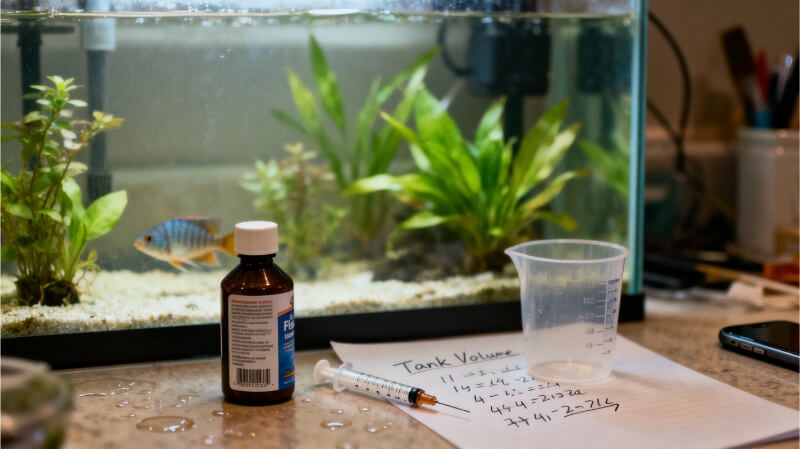
Don’t stop after finding the dosage.
Look for:
- Target species
- Active ingredient
- Treatment duration
- Redosing schedule
- Water-change instructions
- Temperature restrictions
- Contraindications
- Warnings for invertebrates
- Whether carbon should be removed
- Whether additional aeration is recommended
More medication is not better medication.
The concentration, duration, water temperature, oxygen level, and species can all affect how fish respond to a treatment. UK veterinary-product information for fish medications specifically notes that factors such as water temperature, oxygen, concentration, and exposure duration can affect treatment safety and effectiveness.
Author Note: Follow the product directions or veterinary instructions rather than improvising a stronger dose.
7. Check What Your Filter Contains
Medication can interact with filtration.
Activated carbon, for example, is intentionally used to remove certain dissolved compounds from water. That can be useful after treatment but may interfere with some medications while treatment is underway.
Do not automatically remove every piece of filter media, though.
Your biological media supports the bacteria involved in converting ammonia and nitrite through the nitrogen cycle.
Removing all established media while simultaneously treating an already stressed fish can create another problem.
Instead, follow the medication instructions about carbon or other chemical media while preserving biological filtration whenever appropriate.
Continue monitoring ammonia and nitrite during treatment.
8. Consider Whether a Hospital Tank Makes Sense
Treating the entire display aquarium is not always necessary.
A simple hospital or quarantine tank can sometimes let you:
- Observe the fish closely
- Dose a smaller volume accurately
- Protect sensitive tank mates
- Avoid exposing healthy fish unnecessarily
- Keep medication away from plants or invertebrates
- Monitor eating and waste more easily
But moving a critically stressed fish also has costs.
Don’t transfer a fish automatically just because medication is involved.
Consider the condition being treated, whether it may be contagious, how difficult the fish is to catch, and whether the hospital tank is actually ready.
A bare container with unstable temperature and ammonia is not an improvement simply because it is called a quarantine tank.
9. Keep Aquarium Medication Separate From Other Pet Medicines
Multi-pet households often accumulate a surprisingly large medicine cabinet.
There may be aquarium treatments alongside flea products, wormers, prescription drugs, supplements, ear treatments, or medication intended for dogs and cats.
Keep them clearly separated.
Never assume that a medicine used for another pet is safe for fish.
Species metabolize drugs differently, and aquarium treatments may also be administered through the water rather than orally.
For dogs, cats, and other pets that require veterinary medications, established retailers such as Pet Drugs Online operate within a veterinary-prescription system. The company states that prescription products are only dispatched after a valid veterinary prescription has been received and reviewed.
That same principle matters with aquarium fish:
Use medication intended for the species and condition being treated, and involve a veterinarian when prescription treatment or diagnosis is needed.
Author Note: Pet Drugs Online itself also states that its customer-service team cannot diagnose or provide veterinary medical advice, reinforcing the distinction between buying medication and getting an animal properly diagnosed.
Don’t Mix Treatments Unless You Know They’re Compatible
Another common mistake is combining several products because the diagnosis is uncertain.
That can make things worse.
Two products may:
- Contain overlapping ingredients
- Interact unpredictably
- Increase stress
- Affect oxygen levels
- Damage biological filtration
- Be unsafe when combined
If the first medication doesn’t seem to work immediately, resist the urge to start adding others.
Check the expected treatment timeline first.
For veterinary fish medicines, official product information may explicitly warn against mixing products when compatibility has not been established.
When in doubt, ask an aquatic veterinarian rather than creating your own medication cocktail.
Medication Doesn’t Replace Good Husbandry
Even the right medication works inside an environment.
Fish still need:
- Appropriate temperature
- Stable water quality
- Enough oxygen
- Suitable nutrition
- Low stress
- Compatible tank mates
- Proper filtration
If those conditions caused or contributed to the health problem, treating the fish without correcting the aquarium can lead straight back to the same issue.
This is especially important with conditions associated with chronic stress or deteriorating water quality.
The medicine may treat the consequence.
You still have to fix the cause.
A Simple Pre-Medication Checklist
Before adding treatment, ask:
| Check | What you’re looking for |
|---|---|
| Water tested? | Ammonia, nitrite, nitrate and pH checked |
| Temperature verified? | Appropriate for the species |
| Symptoms observed? | More than one clue where possible |
| Other fish checked? | Individual vs tank-wide problem |
| Water volume known? | Dose based on actual water |
| Label read fully? | Warnings and schedule understood |
| Filter considered? | Chemical vs biological media |
| Hospital tank needed? | Only when it improves treatment |
| Medication appropriate? | Correct species and suspected condition |
If several of those questions are unanswered, pause before medicating.
A few extra minutes spent investigating can prevent days of treating the wrong problem.
FAQ’s
Should I medicate a fish as soon as it looks sick?
Usually not before checking water quality, temperature, symptoms, and recent tank changes. Environmental problems can mimic disease and need correction first.
Should I remove activated carbon when treating aquarium fish?
Some medications instruct you to remove carbon because it can adsorb dissolved compounds. Always follow the specific treatment label rather than removing filter media automatically.
Can I use medicine intended for dogs or cats on aquarium fish?
Do not use another pet’s medication unless an aquatic veterinarian specifically directs it. Drug safety, dosage, delivery method, and metabolism vary significantly by species.