Sometimes an aquarium is healthy, clean, and fully stocked but still looks slightly wrong. The problem often isn’t the fish. It’s that every element has similar visual weight, the plants create no depth, or the eye has nowhere obvious to land.
The good news is that aquarium design is learnable.
You usually don’t need new fish or a completely new setup. Repositioning plants, simplifying hardscape, creating stronger visual layers, and adjusting the way the tank is lit can make an existing aquarium feel dramatically more intentional.
Table of Contents
🎥 Watch the Video: Why Your Aquarium Looks Wrong
1. Build Depth Instead of a Plant Wall
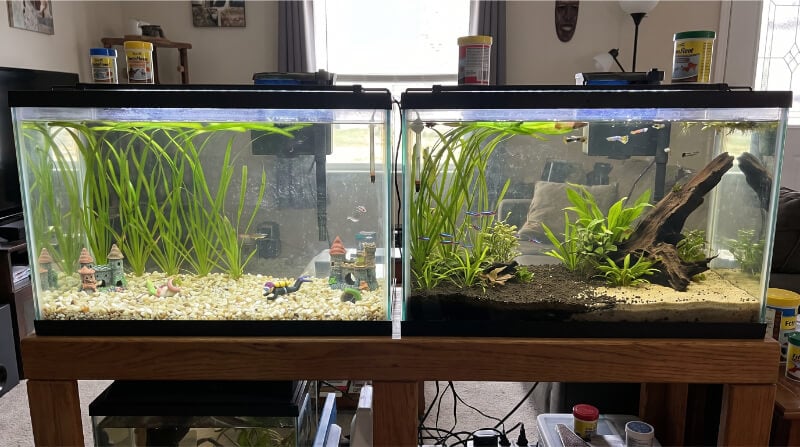
One of the easiest ways to make an aquarium look flat is to line every plant neatly against the back glass.
It feels logical. Tall plants go in the back, so everything tall gets pushed backward.
The problem is that a perfectly even row creates one visual plane.
Instead, think in layers:
| Area | What works well |
|---|---|
| Foreground | Open substrate, low plants |
| Midground | Crypts, compact ferns, smaller hardscape |
| Background | Taller stems, Vallisneria, taller plants |
| Surface | Select floating plants if appropriate |
Pull some vegetation forward. Leave some areas completely open. Group similar plants instead of spacing individual stems evenly across the entire tank.
The plant-focused build in Aquarium Source’s 40-gallon aquascape uses the same foreground, midground, and background approach to create depth.
You don’t need more plants. You need clearer layers.
2. Choose Substrate for the Whole Setup
The script frames bright substrate as inherently bad, but the real issue is more nuanced.
Substrate color affects the visual balance of the aquarium, and research shows that environmental color can also influence fish pigmentation and behavior in species-specific ways. There isn’t one universal color that is biologically or aesthetically best for every fish.
From a design perspective, though, highly reflective white gravel or brightly colored novelty gravel can easily become the first thing your eye notices.
That may be exactly what you want.
If you’re trying to create a more natural-looking planted aquarium, subdued sand, brown gravel, dark gravel, or aquasoil usually lets plants, wood, rocks, and fish carry more of the visual attention.
More importantly, choose substrate based on function first.
If you keep rooted plants, substrate depth, nutrient availability, grain size, and compatibility with the livestock matter more than whether black or tan looks better in a photo.
Our planted substrate guide compares gravel, sand, and planted soils based on how the aquarium will actually use them.
Don’t Replace Substrate Just for Aesthetics
Changing substrate in an established aquarium is disruptive.
Before tearing everything apart, try fixing:
- Plant grouping
- Hardscape placement
- Background color
- Lighting intensity
- Visual clutter
The substrate may become much less noticeable once everything else is working together.
3. Give the Tank a Focal Point
Some aquariums have plenty to look at but nothing to focus on.
A rock here. A small ornament there. Plants everywhere. Another piece of wood on the opposite side.
Everything competes equally.
Instead, choose one main visual anchor.
It might be:
- A large piece of driftwood
- A distinctive rock group
- A dense plant mass
- An open valley framed by plants
- One dominant structural feature
Everything else should support it.
This is one reason negative space matters. Empty areas aren’t wasted aquarium space. They give the eye somewhere to rest and can make the important elements look stronger.
Aquarium Source’s aquarium art guide uses the same principle: plan the layout, establish a focal point, and resist the urge to fill every available corner.
4. Use Hardscape at the Right Scale

Tiny hardscape often disappears visually once the aquarium is filled.
Six little rocks scattered around a 40-gallon tank may look less convincing than two or three larger pieces arranged as one composition.
The same applies to driftwood.
A small stick floating visually in the middle of a large aquarium rarely anchors the design.
Try this instead:
- Use fewer pieces
- Group rocks instead of spacing them evenly
- Let one piece be clearly dominant
- Repeat similar rock textures rather than mixing everything
- Partially bury the base of rocks or wood when appropriate
- Build around the hardscape instead of decorating around the fish
The important qualifier is scale it to the aquarium safely.
A hardscape piece does not need to be enormous simply because bigger is more dramatic. Leave enough room for fish to swim normally, maintain the substrate, and access equipment.
5. Try the Rule of Thirds
The rule of thirds is a composition tool, not an aquarium law.
Imagine dividing the front of the aquarium into a three-by-three grid. Instead of placing your largest rock or driftwood dead center, try positioning the focal area near one of the vertical thirds.
That small shift can make a layout feel less rigid.
Aquarium Source’s aquascaping guide also uses the rule of thirds as a simple starting point for arranging a tank.
But don’t force it.
Some aquascaping styles intentionally use symmetry. Others use central islands, triangular compositions, concave layouts, or heavy asymmetry.
Use the rule as a troubleshooting tool when your tank feels overly centered, not as a formula every aquarium must follow.
6. Fix the Lighting Before Buying More Décor
Lighting changes how every other decision looks.
Too much intensity can make pale substrate dominate the tank, expose every empty area, and encourage algae if light exceeds what the plants can use.
Too little can flatten colors and leave plants struggling.
The most useful adjustment for many tanks is not a complicated sunrise simulation. It’s simply controlling intensity and duration consistently.
A timer makes that much easier.
Aquarium Source’s guide to aquarium lighting explains why the right light depends on the aquarium, livestock, and plants rather than simply running the brightest fixture available.
What About Ramping and Split Lighting?
Gradual sunrise and sunset modes can look excellent and make the viewing experience feel less abrupt.
Use them because you like the effect, not because they’re required for a successful aquarium.
The same caution applies to splitting the photoperiod into morning and evening sessions. It can fit someone’s viewing schedule, but it shouldn’t be presented as a guaranteed algae fix.
If algae is increasing, evaluate the entire system:
- Total light duration
- Light intensity
- Plant mass
- Nutrient availability
- CO2, if used
- Maintenance
- Feeding and waste
Changing the clock alone may not solve the underlying imbalance.
Before You Buy Anything, Remove Something
When an aquarium feels disappointing, the natural reaction is to add another plant, another rock, or another ornament.
Try the opposite.
Remove one or two elements and look again.
A cleaner layout often makes existing pieces look more intentional because there is less competition for attention.
This works especially well when:
- Several ornaments are similar in size
- Plants are evenly distributed everywhere
- Multiple hardscape styles are mixed
- There is no open substrate
- Every section has equal visual density
You can always put something back.
The Order I’d Fix an Existing Aquarium
Don’t tear everything apart at once.
Start with the least disruptive changes and stop when the tank begins to work visually.
Step 1: Remove obvious clutter
Take out decorations or small hardscape pieces that don’t contribute to the overall layout.
Step 2: Choose one focal area
Decide where you want the eye to land first.
Step 3: Regroup the plants
Create distinct masses and different heights rather than an even row.
For easy species that can help build those layers, Aquarium Source’s beginner aquarium plants are a practical starting point.
Step 4: Reposition the hardscape
Build around the focal area and leave intentional open space.
Step 5: Adjust lighting
Reduce unnecessary intensity or duration before assuming you need a new fixture.
Step 6: Reconsider the substrate last
If the substrate still dominates the look or doesn’t fit your plants and livestock, then a larger rebuild may be worthwhile.
A Better-Looking Tank Usually Needs Better Decisions, Not More Stuff
A visually strong aquarium doesn’t require expensive stone, rare plants, or professional aquascaping equipment.
The basics do most of the work:
- Clear visual hierarchy
- Varied plant height
- Appropriate substrate
- One strong focal area
- Hardscape that matches the scale of the tank
- Intentional empty space
- Lighting that supports the livestock and plants
Most importantly, aesthetics come after animal needs.
Never sacrifice swimming room, appropriate substrate, hiding places, or safe equipment placement just to make a composition look better.
The best aquarium is one where the design and the habitat work together.
FAQ’s
Why does my aquarium look flat?
Aquariums often look flat when plants sit in one row against the back glass. Vary plant heights, create foreground and midground layers, and leave some open space.
Does dark substrate make aquarium fish look better?
Dark substrate can create stronger visual contrast and may affect pigmentation in some species, but results vary. Choose substrate for livestock and plant needs first.
Where should the focal point be in an aquarium?
A focal point often works well slightly off-center near a rule-of-thirds intersection, but it is only a design guideline. The best placement depends on the layout style.