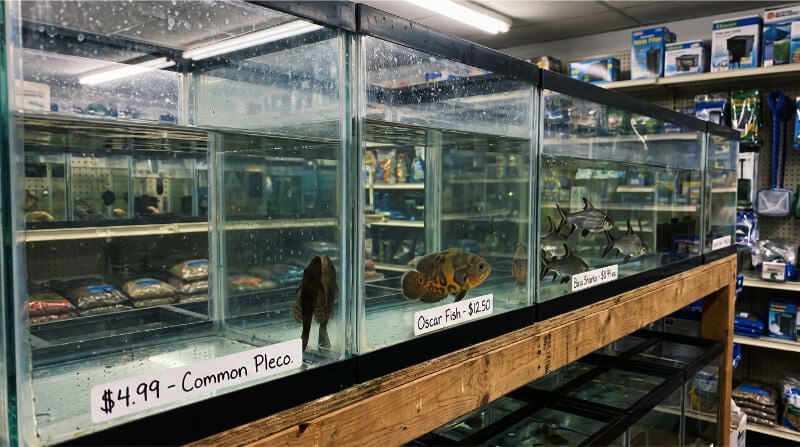
A two-inch fish at the pet store does not necessarily stay a two-inch fish.
Some of the most commonly sold freshwater species eventually become large, territorial, highly active, or demanding enough that an ordinary beginner aquarium simply cannot accommodate them.
That does not make these fish bad choices for everyone. It means you should research the adult fish rather than buying based on the juvenile in front of you. Tank dimensions, adult size, social behavior, lifespan, filtration demands, and compatibility matter much more than the price tag.
Table of Contents
🎥 Watch the Video: Fish You Should Research Before Buying
Why Small Fish at the Store Can Be Misleading
Aquarium stores naturally sell juvenile fish because juveniles are easier to transport, house, and sell.
The problem is that adult requirements may bear little resemblance to what you see in the sales tank.
A fish that is three inches long today might eventually need:
- Several feet of swimming length
- A much larger social group
- Powerful filtration
- Carefully selected tank mates
- A decade or more of care
The RSPCA specifically recommends choosing an aquarium based on how large a fish will become and notes that some catfish, including pangasius species, can become unsuitable for typical home aquariums because of their eventual size.
Author Note: So before buying any fish, research its adult size, not just its current size.
1. Common Pleco
Common plecos are a perfect example of why common does not mean small.
The name “common pleco” is also used somewhat loosely in the aquarium trade for several large suckermouth catfish, which makes precise adult-size claims difficult. The practical takeaway is simpler: many fish sold under that label can become far larger than beginners expect.
Our common pleco care guide lists commonly sold specimens as potentially reaching 15 to 24 inches and recommends substantially more space than a typical beginner community aquarium.
That creates two problems.
First, a large pleco needs physical room to move and turn comfortably. Second, large plecos can produce a surprising amount of waste. Buying one purely as a “cleanup fish” can therefore increase the filtration and maintenance demands of the aquarium.
A Smaller Alternative
If the appeal is a sucker-mouth catfish for a moderate-sized aquarium, a bristlenose pleco is usually much easier to accommodate.
Aquarium Source lists bristlenose plecos at roughly three to four inches in many setups, dramatically changing the space equation.
It still needs proper food and care. No pleco should be purchased as disposable janitorial staff.
2. Red Tail Shark
At the store, the red tail shark is difficult to ignore.
Its black body and bright red tail make it look like an ideal centerpiece fish.
The complication is temperament.
Red tail sharks become increasingly territorial as they mature, particularly around other bottom-oriented or similarly shaped fish. Seriously Fish describes them as territorial and recommends a tank footprint around 48 by 18 inches as the smallest worth considering.
Our red tail shark guide similarly recommends a substantially larger aquarium than many shoppers expect from seeing a juvenile specimen.
This does not mean a red tail shark cannot live with other fish. It means tank mates and layout need to be selected around its territory rather than treating it as an ordinary peaceful community fish.
3. Oscar
Oscars create a different kind of problem.
They are intelligent-looking, interactive cichlids that are extremely easy to become attached to. Unfortunately, the cute juvenile at the store can become a very substantial adult.
FishBase records Oscars reaching roughly 40 cm and reports maximum specimens even larger than that.
Large Oscars also have large mouths.
Small community fish that comfortably coexist with a juvenile may eventually become potential food. They also produce enough waste that filtration needs to be planned around the adult fish.
Our Oscar care guide recommends them for aquarists who understand their aggression, size, and space requirements rather than treating them as beginner community fish.
An Oscar can be an excellent centerpiece.
It just needs to be the centerpiece of an aquarium designed for an Oscar.
4. Goldfish
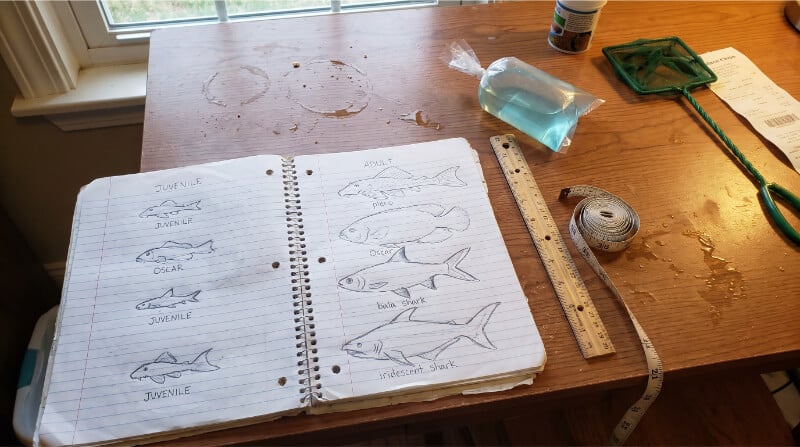
Goldfish might be the clearest example of a fish whose marketing image does not match its biology.
The classic image is still a tiny fish in a tiny bowl.
That is not an appropriate long-term setup.
There is also an important distinction between fancy goldfish and long-bodied common or comet goldfish. Commons and comets are larger and more active, while fancy varieties generally have shorter, rounder bodies and different swimming characteristics.
Aquarium Source lists comet goldfish at around 12 inches and notes lifespans of roughly 10 to 20 years with appropriate care.
Tank-size recommendations vary between organizations and should account for the fish’s variety, adult dimensions, group size, filtration, and swimming space. What does not vary much is the conclusion that a small bowl is unsuitable for long-term goldfish care.
Goldfish can make excellent pets.
They simply should not be treated as temporary decorations.
5. Bala Shark
Bala sharks are peaceful, sleek, silver fish that look manageable when sold as juveniles.
Adults are another story.
FishBase reports a maximum length of about 35 cm, nearly 14 inches, and notes that the species should be kept in groups of five or more with an aquarium length exceeding 150 cm.
That combination is what catches buyers off guard.
One 14-inch fish requires considerable swimming room. A group of active 14-inch fish requires an entirely different class of aquarium.
Our bala shark care guide recommends roughly 120 to 150 gallons, illustrating how quickly this species moves beyond the typical beginner setup.
A bala shark is therefore a poor impulse purchase even though its temperament is relatively peaceful.
The limitation is primarily scale.
6. Iridescent Shark
If there is one fish on this list that most dramatically demonstrates the juvenile-versus-adult problem, it is the iridescent shark.
Juveniles are attractive silver catfish with dark stripes and a shark-like silhouette.
Adults can become enormous.
FishBase records Pangasianodon hypophthalmus at a maximum length of 130 cm, or roughly 51 inches. These are migratory river fish native to major Southeast Asian river systems.
That does not mean every aquarium specimen reaches the published maximum, but even substantially smaller adults are enormous by home-aquarium standards.
Our iridescent shark guide therefore emphasizes that only aquarists with the necessary space and resources should attempt to keep them.
They are also active swimmers that can react strongly when startled, making physical tank dimensions especially important.
For most home aquarists, this is a fish to admire rather than purchase.
Quick Comparison
| Fish | What surprises buyers | Better fit for most beginners? |
|---|---|---|
| Common pleco | Large adult size and waste | Bristlenose pleco |
| Red tail shark | Territorial behavior | Peaceful centerpiece species |
| Oscar | Size, predation, waste | Smaller community centerpiece |
| Goldfish | Size, lifespan, waste | Appropriate fancy variety with proper setup |
| Bala shark | Large adult size plus social needs | Smaller schooling species |
| Iridescent shark | Potentially enormous adult size | Smaller active schooling fish |
The alternative does not need to look identical.
The goal is to identify what attracted you to the original fish and find a species that provides that trait at a scale your aquarium can support.
Five Questions to Ask Before Buying Any Fish
Before taking a fish home, look up these five things:
- How large does it get as an adult?
- Does it need companions of its own species?
- What tank dimensions does an adult need?
- What does it eat, and what might eat it?
- How long can it live?
Then compare those answers with the aquarium you actually own, not the aquarium you might buy someday.
“I’m going to upgrade later” is risky stocking logic because fish growth does not wait for your schedule.
If the adult setup is unrealistic now, choosing another species is usually the better decision.
The Real Problem Isn’t the Fish
None of these species deserves a bad reputation.
Common plecos, red tail sharks, Oscars, goldfish, bala sharks, and iridescent sharks can all be fascinating animals under suitable conditions.
The problem starts when the fish is sold as though the juvenile in the store represents the animal you are committing to.
A little research before purchase changes that.
Look beyond the price, color, and current size. Check the adult fish, the required group, the tank footprint, behavior, filtration needs, and lifespan.
Five minutes of research at the store can prevent years of trying to solve a stocking decision that should never have been made in the first place.
FAQ’s
Which pet store fish get much bigger than beginners expect?
Common plecos, Oscars, bala sharks, iridescent sharks, and common or comet goldfish can all become dramatically larger than the juveniles typically sold in stores.
Are common plecos good algae eaters for small tanks?
Common plecos may graze algae, but many become far too large for small aquariums and produce substantial waste. A properly researched smaller pleco may be more suitable.
Should I trust the size of a fish at the pet store?
No. Most aquarium fish are sold as juveniles. Research adult size, tank dimensions, social needs, behavior, and lifespan before deciding whether a species fits your tank.


