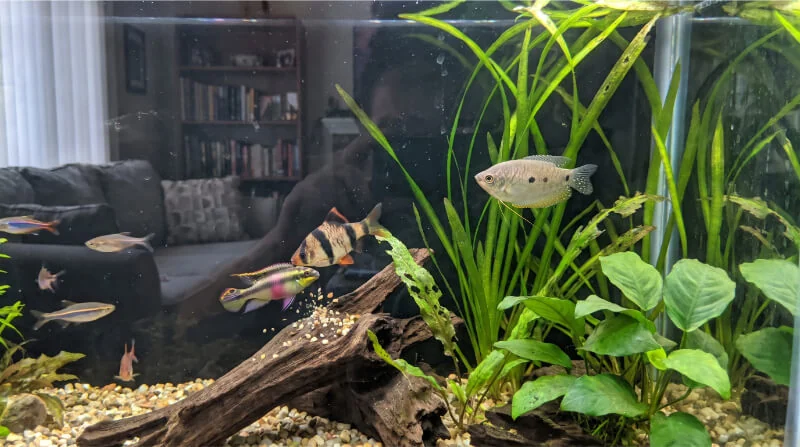
Some freshwater fish earn a “peaceful community fish” reputation that doesn’t tell the whole story.
That doesn’t make them bad fish. It means their behavior can change with age, group size, breeding, tank mates, available territory, and individual temperament.
The biggest surprises usually come from fish that look small, slow, cute, or harmless in the store but behave very differently once settled into an aquarium.
Here are 10 worth researching carefully before adding them to a community tank.
Table of Contents
- Zebra danio
- Serpae tetra
- Tiger barb
- Three-spot gourami
- Pictus catfish
- Kissing gourami
- Dwarf pea puffer
- Paradise fish
- Chinese algae eater
- Convict cichlid
- What to do if aggression starts
- Four questions to ask before buying
🎥 Watch the Video: These Fish Look Peaceful. They’re Not.
Quick Comparison
| Fish | Main risk | What usually helps |
|---|---|---|
| Zebra danio | Chasing, occasional fin nipping | Proper group, active tank mates |
| Serpae tetra | Fin nipping | Larger group, avoid flowing fins |
| Tiger barb | Persistent fin nipping | Proper school, robust tank mates |
| Three-spot gourami | Territorial behavior | Space, cover, careful pairing |
| Pictus catfish | Eating very small fish | Larger tank mates |
| Kissing gourami | Size, pushing, territorial behavior | Large aquarium, robust companions |
| Dwarf pea puffer | Fin nipping, predation | Species-focused setup |
| Paradise fish | Male aggression | One male, cover, sturdy tank mates |
| Chinese algae eater | Adult territorial behavior | Careful long-term stocking |
| Convict cichlid | Strong breeding aggression | Dedicated or carefully planned setup |
10. Zebra Danio
Zebra danios are hardy, active, and genuinely useful beginner fish.
They’re also extremely energetic.
That becomes a problem when they’re paired with slow fish carrying long fins. Persistent chasing or occasional fin nipping can stress species such as bettas, fancy guppies, or long-finned gouramis.
The risk tends to be higher when danios are kept in groups that are too small because more of their social energy may be directed toward other fish.
Better approach
Keep a proper group and choose tank mates that can comfortably handle the same fast-paced environment.
Think active community, not slow-moving showcase fish.
9. Serpae Tetra
Serpae tetras are small, colorful, and frequently described as community fish.
They are also known for nipping fins.
Our serpae tetra guide recommends keeping them in a group and specifically warns about slow-moving fish with long fins.
The highest-risk combinations include:
- Bettas
- Fancy guppies
- Angelfish
- Other slow long-finned species
A larger group can help keep more interaction within the school, but it does not guarantee perfect behavior.
If you want the same small-schooling-fish look with less concern about fin damage, calmer rasboras or tetras may be easier to build around.
8. Tiger Barb
Tiger barbs take the fin-nipping issue one step further.
FishBase specifically advises keeping them in groups and not keeping them with long-finned fish.
Our tiger barb guide also classifies them as semi-aggressive and recommends larger groups to reduce bullying.
That doesn’t mean a tiger barb aquarium has to be chaotic.
A well-planned group with:
- Plenty of swimming space
- Plants and hardscape
- Similar-sized active fish
- No tempting flowing fins
can work very well.
What doesn’t work nearly as reliably is dropping a handful of tiger barbs into a peaceful tank and hoping they’ll ignore a betta or angelfish.
7. Three-Spot Gourami
Three-spot gouramis include the common blue and gold varieties.
They look slow and graceful, but males can become territorial, especially toward other gouramis.
FishBase lists adults at up to roughly 15 cm, or about six inches.
Our three-spot gourami guide also notes that temperament varies and that males can become territorial.
The important part is individual behavior
One fish may live quietly in a community for years.
Another may decide that half the tank belongs to it.
Give them:
- Enough horizontal space
- Plants and visual barriers
- Tank mates that are not extremely timid
- Room to avoid one another
Avoid assuming that “gourami” automatically means gentle centerpiece fish.
6. Pictus Catfish
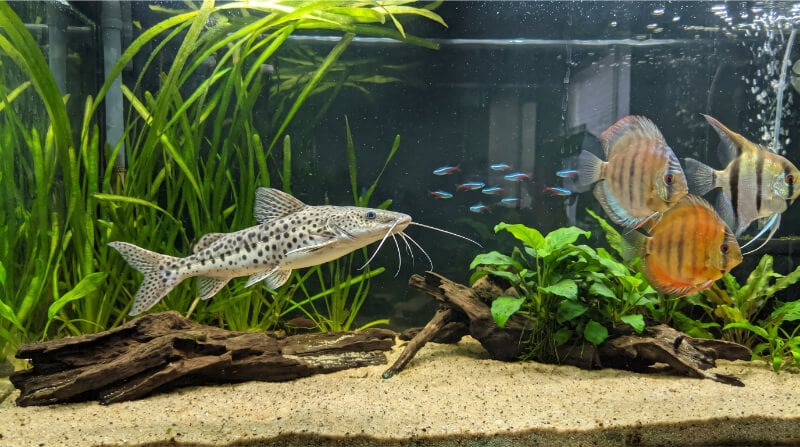
Pictus catfish are a good example of the difference between aggressive and predatory.
They are not necessarily looking for fights.
But they are catfish with a mouth capable of swallowing small fish.
Our pictus catfish guide describes them as peaceful overall, which is fair when they’re kept with appropriately sized tank mates.
The issue appears when very small fish are added.
A tiny tetra resting at night can become food even if the pictus never showed territorial aggression during the day.
Safer tank mates
Choose fish that are clearly too large to swallow.
Also be careful when handling pictus catfish. Their spines can become tangled in nets, so a rigid container can sometimes be safer during transfers.
5. Kissing Gourami
The name does this fish no favors.
When two kissing gouramis press their mouths together, it isn’t necessarily affection. That behavior can be a dominance interaction.
They also get considerably larger than many buyers expect.
FishBase reports a maximum size around 30 cm, or roughly 12 inches, and notes that they need substantial aquarium space.
Our kissing gourami guide also describes them as semi-aggressive and warns that they can push or harass weaker fish.
The lesson here is less “kissing gouramis are aggressive” and more:
Don’t plan around the cute juvenile you see at the store.
Plan around the much larger adult.
4. Dwarf Pea Puffer
Few fish look less threatening than a pea puffer.
They are tiny, curious, and have huge eyes.
They are also predators.
Pea puffers naturally hunt small invertebrates and can nip the fins of other fish, especially slow-moving species.
Some experienced keepers successfully maintain them in carefully designed communities.
But for most beginners, a species-focused setup is much easier to manage.
Tiny size does not equal peaceful temperament.
3. Paradise Fish
Paradise fish are beautiful labyrinth fish with flowing fins and striking color.
Males can also be surprisingly combative.
FishBase specifically notes that males fight each other, and the species also feeds on small aquatic animals, including small fish.
Our paradise fish guide describes their aggression as situational, which is a useful way to think about them.
A young fish may seem completely calm.
Territorial behavior can become much more noticeable after maturity.
If you want one in a community:
- Avoid multiple adult males
- Provide visual barriers
- Use sturdy tank mates
- Watch behavior closely
2. Chinese Algae Eater
The Chinese algae eater may be the most misleading fish on this list because its name sounds like a job description.
Young fish graze algae and may seem harmless.
Adults can be very different.
FishBase lists Gyrinocheilus aymonieri at up to about 28 cm, or 11 inches, and notes that adults can be territorial.
Our Chinese algae eater guide similarly lists the species as semi-aggressive and around 10 to 11 inches at maturity.
Some adults may also harass slower fish.
That makes buying one simply because you have algae a poor strategy.
If algae is the problem, solve the algae problem first.
Choose an algae-eating species only if you genuinely want to keep that animal for its entire life.
1. Convict Cichlid
Convict cichlids are small compared with many famous aggressive cichlids.
That makes them easy to underestimate.
FishBase lists adults around 10 cm, or about four inches, but size is not the main issue.
The problem is territory, especially during breeding.
Our convict cichlid guide describes them as aggressive, territorial, and extremely easy to breed.
Once a pair establishes a spawning site, they can defend that area aggressively against fish much larger than themselves.
That’s fascinating behavior in the right setup.
It is much less entertaining when the rest of a peaceful community tank is trapped at the opposite end of the aquarium.
A dedicated setup or carefully planned cichlid community is much more appropriate than treating convicts like ordinary community fish.
If You Already Own One of These Fish
Don’t panic and don’t remove fish just because they appear on this list.
Watch the actual aquarium.
Look for repeated patterns such as:
- Torn fins
- One fish hiding constantly
- Persistent chasing
- A fish being prevented from eating
- One individual controlling a large territory
- Small fish disappearing
- Aggression increasing during breeding
Occasional chasing is not automatically a crisis. Repeated harassment is different.
Start with the environment
Try:
- Adding plants
- Adding caves
- Breaking up sightlines
- Rearranging hardscape
- Increasing group size when appropriate
- Confirming the tank is large enough
Rearranging the tank can sometimes disrupt established territories.
But if one fish continues being targeted, separation is usually safer than waiting indefinitely for the problem to fix itself.
Four Questions to Ask Before Buying Any Community Fish
1. How large does it get?
Research adult size, not store size.
2. Does it need a group?
Some species become more stressed or troublesome when kept in insufficient numbers.
3. What can fit in its mouth?
A peaceful predator is still a predator.
4. What happens when it matures or breeds?
Juvenile behavior is not always adult behavior.
Our community fish guide is a good starting point when building a mixed freshwater aquarium, but compatibility should always be checked species by species.
“Peaceful” Is Only a Starting Point
Compatibility labels are useful shorthand.
They are not guarantees.
A fish can be:
- Peaceful toward similar-sized fish
- Aggressive only while breeding
- Territorial toward its own species
- A fin nipper without being territorial
- Predatory without being aggressive
- Completely calm until it reaches maturity
That is why good community stocking goes beyond the word printed on a pet-store label.
Research the adult fish, give it the right social structure and space, and pay attention to what actually happens after it enters the tank.
FAQ’s
Can peaceful fish still attack other fish?
Yes. “Peaceful” is a general label, not a guarantee. Territorial behavior, breeding, inadequate group size, predation, and individual temperament can all change compatibility.
Do larger schools stop fin-nipping fish from nipping?
Larger groups can reduce problems in species such as tiger barbs and danios by directing more interaction toward their own kind, but they do not guarantee that fin nipping stops.
What should I do if one fish keeps chasing another?
Check tank size, group requirements, hiding places, and compatibility first. Add visual barriers if appropriate. If persistent harassment continues, separation may be necessary.


