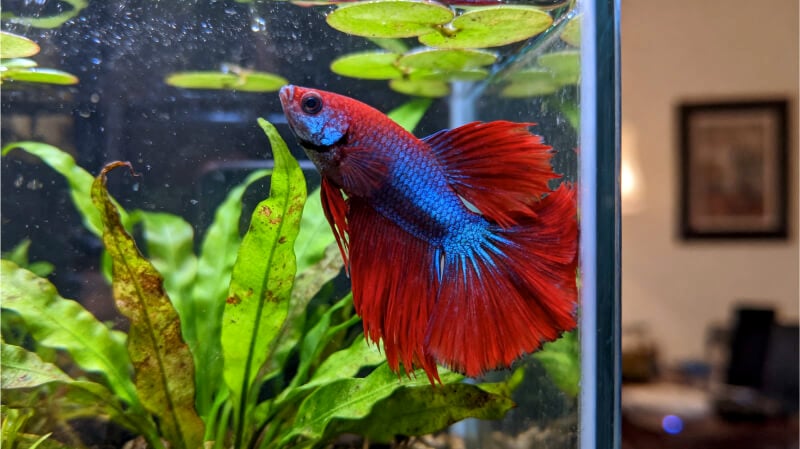
Betta behavior is useful because changes in activity, posture, appetite, and color can help you notice when something is different.
But behavior needs context. A betta resting on a leaf may be perfectly normal. The same fish lying on the substrate with clamped fins, pale color, and no appetite deserves a much closer look.
Table of Contents
1. Glass Surfing
“Glass surfing” describes repetitive swimming along the aquarium glass, often up and down or back and forth.
It can happen for several reasons:
- Reflections
- Territorial behavior
- Stress
- A tank that feels too exposed
- Water-quality problems
- Environmental simplicity
- Temporary adjustment after a move
Aquarium Co-Op notes that glass surfing does not always mean the same thing, and hobbyists often reduce it by changing reflections, flow, cover, or enrichment.
So the first step is not to assume boredom.
Check:
- Ammonia and nitrite
- Temperature
- Tank size
- Flow
- Reflections
- Hiding places and plant cover
If the water is good and the behavior is persistent, then the layout becomes worth adjusting.
Our betta care guide covers the basic setup requirements that make those behavioral checks easier.
2. Flaring
Flaring is normal betta behavior.
A betta spreads its fins and gill covers to look larger when it perceives a rival or threat.
Brief flaring at a reflection or movement can be normal.
The concern is constant flaring.
If your betta spends large portions of the day displaying at:
- Its reflection
- Another fish
- A nearby tank
- A reflective decoration
then the trigger should be reduced.
Try:
- Changing the background
- Adjusting lighting
- Moving reflective décor
- Blocking sightlines
- Reconsidering tank mates
Normal behavior becomes a problem when the fish cannot disengage from it.
3. Bubble Nests
Bubble nests are one of the most misunderstood betta behaviors.
Male bettas build nests of bubbles at the surface as part of reproductive behavior. The nest is used during spawning to hold eggs and early fry.
That means a bubble nest is normal behavior, but it does not prove the fish is happy, perfectly healthy, or ready to breed.
FishLab notes that there is no strong evidence that bubble-nest building should be interpreted as a direct measure of happiness.
So:
Bubble nest present: normal reproductive behavior
No bubble nest: not automatically a problem
A healthy male may build one frequently, occasionally, or not at all.
Floating plants can provide useful surface structure and may also give a betta somewhere to rest. Our guide to floating plants covers several aquarium-safe options.
4. Clamped Fins
A healthy betta usually carries its fins loosely and naturally.
When the fins stay pulled tightly toward the body, something may be wrong.
Clamped fins can be associated with:
- Poor water quality
- Incorrect temperature
- Stress
- Illness
- Injury
- Acclimation
They are a warning sign, not a diagnosis.
PetMD lists changes in fin position, activity, color, appetite, and swimming behavior among signs that should prompt closer evaluation.
What to do first
Test the water before reaching for medication.
Check:
- Ammonia
- Nitrite
- Nitrate
- Temperature
If those are appropriate and the fins remain clamped, examine the fish for physical signs such as lesions, white spots, swelling, damaged fin edges, or abnormal breathing.
Our fish health guide can help separate general stress signs from visible disease symptoms.
5. Bottom Sitting and Lethargy
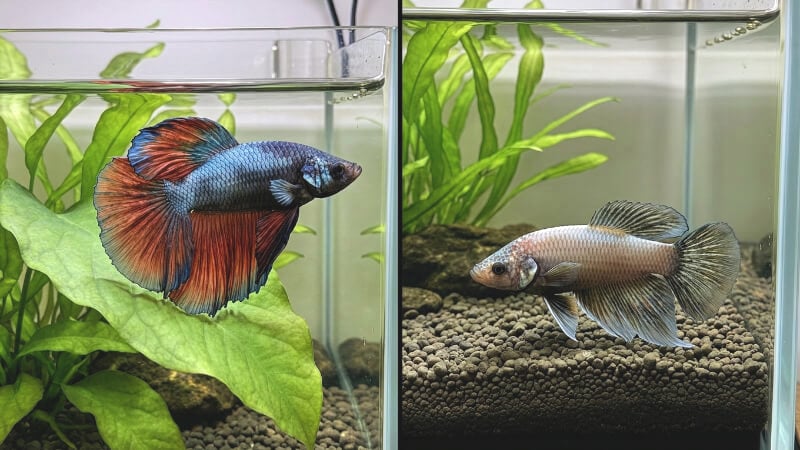
This is one of the behaviors where context matters most.
Bettas naturally rest.
They may sit:
- On broad leaves
- Near floating plants
- On decorations
- Close to the surface
That can be completely normal.
The concern is a betta that spends unusual amounts of time on the bottom and shows other changes.
Watch for:
- Clamped fins
- Loss of appetite
- Rapid breathing
- Pale or unusual coloration
- Difficulty swimming
- Abdominal swelling
Temperature is also worth checking immediately.
PetMD currently recommends approximately 76–81°F for bettas and emphasizes stable warm water.
A cold betta may become sluggish because metabolism slows.
6. Color Changes
Color can provide useful information, but it needs to be interpreted carefully.
Bettas may change appearance because of:
- Stress
- Illness
- Temperature
- Lighting
- Age
- Genetics
- Natural color development
A sudden change that happens alongside lethargy, appetite loss, or abnormal swimming deserves attention.
PetMD includes dull coloration and changes in markings among reasons to evaluate a betta’s health more closely.
What About Stress Bars?
Horizontal striping is commonly associated with stress in bettas, especially females and younger fish.
Vertical barring in females can occur in reproductive contexts.
But color pattern alone should never override the rest of the fish’s condition.
If the fish is swimming normally, eating, and living in appropriate water, one marking should not trigger panic.
7. Appetite Changes
Appetite is one of the most useful day-to-day observations you can make.
A healthy betta will usually respond predictably to food.
If your fish suddenly stops eating, check:
- Temperature
- Water quality
- Bloating
- Mouth or gill abnormalities
- Swimming behavior
- Recent diet changes
PetMD recommends a high-protein diet formulated for bettas and notes that overfeeding can create both health and water-quality problems.
And if your Betta is not eating, we have a simple checklist that can help.
Don’t Automatically Feed Peas
Older aquarium advice often recommends shelled peas for constipation.
We would not make that our default recommendation for bettas.
Bettas are primarily carnivorous insect-eaters, so a better first response to mild suspected overfeeding is usually to stop adding food temporarily, correct the feeding routine, and evaluate the fish for other symptoms.
If swelling, buoyancy problems, or food refusal persist, treat it as a health issue rather than assuming simple constipation.
What Does a Healthy Betta Usually Look Like?
There is no single behavior that proves a betta is “happy.”
Instead, look for a pattern.
A healthy betta generally has:
- Regular, controlled swimming
- Good appetite
- Normal coloration for that individual
- Fins carried naturally
- Curiosity about its surroundings
- Normal resting periods
- No persistent gasping
- No unexplained swelling or lesions
PetMD similarly lists bright coloration, intact fins, active swimming, and good appetite among signs of a healthy betta.
The useful skill is learning your fish’s normal baseline.
A betta that has always rested frequently may be fine.
A betta that suddenly stops exploring, clamps its fins, and refuses food is telling you something has changed.
That’s when behavior becomes genuinely useful.
FAQ’s
Why is my betta swimming up and down the glass?
Glass surfing can result from reflections, stress, territorial behavior, tank conditions, or environmental factors. Check water quality and temperature before changing décor.
Does a bubble nest mean my betta is happy?
Not necessarily. Bubble nests are normal reproductive behavior in male bettas, but their presence or absence is not a reliable standalone measure of health or happiness.
Why is my betta sitting on the bottom?
Bettas rest naturally, but prolonged bottom sitting with clamped fins, poor appetite, pale color, or abnormal breathing can indicate temperature, water-quality, or health problems.


